Explore our network of country and industry based websites to access localized information, product offerings, and business services across our group.
Log in to start sending quotation requests for any product.
Don't have an account? Sign Up Here
Home Liquid Glucose Applications and Market Growth in Global Industry
Trade Insights | Applications and Buyers | 03 June 2026
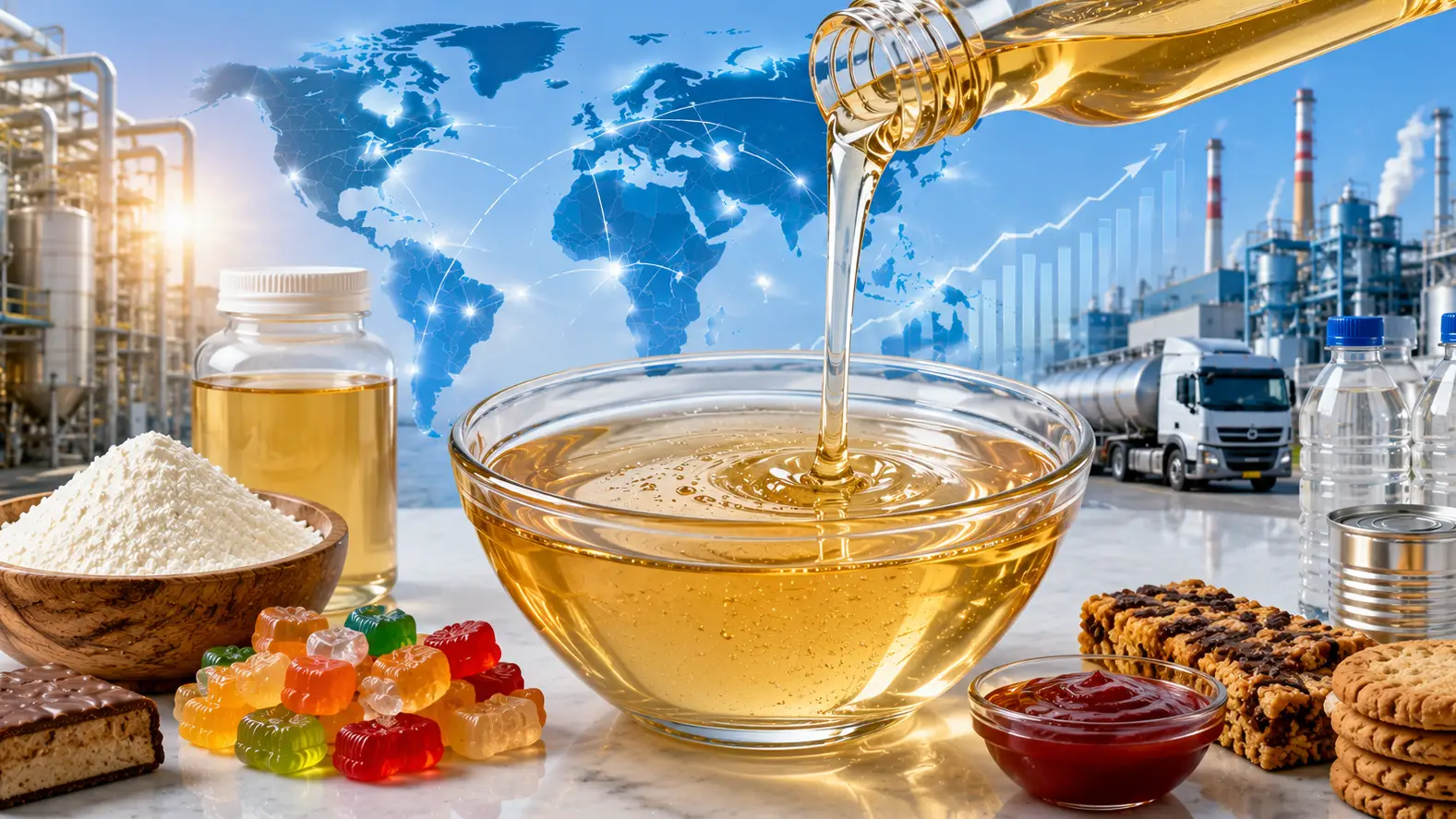
Introduction to Liquid Glucose and Industrial Relevance
Liquid Glucose in Food and Beverage Manufacturing
Pharmaceutical and Industrial Applications of Liquid Glucose
Global Market Demand and Industry Growth Trends
Buyer Intent and Procurement Considerations in Liquid Glucose Sourcing
Strategic Sourcing and Supply Chain Outlook for Liquid Glucose
Conclusion: Industrial Value and Market Positioning
Liquid glucose is a purified, concentrated solution of glucose obtained through the hydrolysis of starch, typically sourced from corn, wheat, or rice. According to the U.S. Food and Drug Administration (FDA), starch-based sweeteners such as glucose syrup are widely utilized in processed food manufacturing due to their functional and stabilizing properties (FDA Food Additive Status List).
In industrial applications, liquid glucose is more than just a sweetening agent. It plays a critical functional role by providing viscosity control, moisture retention, crystallization prevention, and texture enhancement across multiple product categories. These properties make it indispensable in large-scale food production systems.
Unlike sucrose, liquid glucose has lower sweetness intensity but significantly higher functional stability, which makes it highly suitable for industrial formulations requiring consistency and shelf-life extension. As global demand for processed and packaged food continues to rise, its importance in manufacturing systems continues to grow.
Liquid glucose is a key component within the broader starch derivatives industry, which includes products such as maltodextrin and high-fructose syrups. According to FAO-aligned starch processing insights, starch-derived sweeteners are essential inputs in modern food and beverage systems that rely on scalable, cost-efficient raw materials.
Within the supply chain, liquid glucose serves as an intermediate product between raw starch extraction and final food formulation. This makes it a foundational material in industrial food manufacturing, where consistency and process efficiency are critical.
Its industrial relevance is particularly strong in regions with established corn and wheat processing industries, which serve both domestic consumption and global export markets. As industrial food production expands worldwide, liquid glucose continues to strengthen its position as a core ingredient in the sweetener value chain.
In confectionery manufacturing, liquid glucose is widely used to prevent sugar crystallization and improve texture in products such as candies, gummies, and caramel. Industry guidance from the European Food Safety Authority (EFSA) highlights its role in maintaining stability and consistency in sugar-based formulations.
In bakery applications, liquid glucose contributes significantly to moisture retention, softness, and extended shelf life. Products such as cakes, pastries, and dough-based goods benefit from improved structural stability during both production and storage.
Industrial bakeries rely on liquid glucose to ensure uniform product quality across large-scale automated production systems. This consistency is essential for manufacturers supplying standardized products across regional and global markets.
In the beverage industry, liquid glucose is commonly used as a sweetening agent and body enhancer. It improves mouthfeel, stabilizes flavor profiles, and supports formulation consistency in syrups, soft drinks, and energy beverages.
According to USDA sweetener market insights, glucose syrups are increasingly adopted in processed foods due to their cost efficiency and functional advantages compared to traditional sucrose-based sweeteners.
Beyond beverages, liquid glucose is widely used in sauces, jams, dairy products, and processed foods where viscosity control and product stability are required. These applications highlight its versatility across multiple food categories.
Rising global consumption of packaged beverages and convenience foods continues to drive strong demand for liquid glucose in this segment.
Liquid glucose plays an important role in pharmaceutical manufacturing as a binder, stabilizer, and sweetening agent in oral dosage forms. According to the World Health Organization (WHO), excipients such as glucose syrup are essential for improving palatability and formulation stability in medicinal products.
It is widely used in cough syrups, pediatric formulations, and vitamin-based liquid medicines. Its high solubility and non-toxic nature make it suitable for regulated pharmaceutical applications.
Manufacturers also use liquid glucose to ensure uniform consistency and stability in liquid dosage systems. This expands its industrial relevance beyond food into healthcare and medical manufacturing sectors.
In industrial biotechnology, liquid glucose serves as a primary carbon source in fermentation processes. It is widely used in the production of ethanol, organic acids, enzymes, and other bio-based chemicals.
Scientific research in biotechnology journals indicates that glucose-based substrates are preferred due to their high fermentability and consistent microbial performance in controlled environments.
This makes liquid glucose a critical input in large-scale bioprocessing systems, including biofuel production and industrial enzyme manufacturing.
As global industries move toward renewable and bio-based production systems, demand for fermentation-grade glucose continues to increase steadily.
Global demand for liquid glucose is closely tied to the expansion of processed food industries. Market analysis from Grand View Research and FAO-aligned food outlook data indicates consistent growth in starch-based sweetener consumption worldwide.
Urbanization, rising incomes, and changing dietary patterns have significantly increased demand for packaged and convenience foods. This directly drives the need for functional ingredients like liquid glucose.
Food manufacturers prefer liquid glucose due to its cost efficiency, stability, and adaptability in multiple formulations.
This demand trend is particularly strong in Asia-Pacific and Middle Eastern markets, where food processing industries are expanding rapidly.
The production of liquid glucose is heavily dependent on agricultural raw materials such as corn and wheat. USDA commodity reports highlight that starch availability directly influences sweetener production capacity and pricing stability.
This dependency creates a strong link between agricultural markets and industrial chemical supply chains. Any fluctuations in crop yield or commodity pricing can directly impact glucose syrup availability.
As a result, global buyers increasingly monitor agricultural trends when planning procurement strategies for liquid glucose.
Supply chain resilience has therefore become a key concern for manufacturers relying on uninterrupted production inputs.
Liquid glucose buyers typically include food manufacturers, beverage producers, pharmaceutical companies, and industrial fermentation facilities. These buyers prioritize consistent quality, regulatory compliance, and stable supply availability.
Procurement teams evaluate key specifications such as viscosity grade, dextrose equivalent (DE), purity levels, and food-grade certification standards.
Because liquid glucose is used in continuous production processes, bulk purchasing is common across industrial buyers.
Supplier reliability is therefore a critical factor influencing long-term procurement decisions.
In global chemical trade, buyers evaluate suppliers based on pricing competitiveness, logistics efficiency, quality assurance systems, and certification compliance.
While price is important, supply consistency and reliability often carry greater weight in procurement decisions.
Many companies also assess export capability, delivery timelines, and technical support when selecting suppliers.
B2B platforms such as Tradeasia and Chemtradeasia play an important role by connecting buyers with verified global suppliers, improving transparency and procurement efficiency.
Liquid glucose supply chains depend on agricultural production cycles, refinery capacity, and global logistics networks. According to OECD agricultural trade analysis, supply chain resilience has become a top priority for food manufacturers worldwide.
Industrial buyers require uninterrupted supply to maintain continuous production lines and avoid operational disruptions.
This has increased the importance of diversified sourcing strategies across multiple regions.
Reliable suppliers are essential for maintaining stability in downstream manufacturing industries.
B2B chemical marketplaces simplify procurement by providing centralized access to multiple verified suppliers and product specifications. This improves transparency and reduces sourcing time for industrial buyers.
Platforms such as Tradeasia and Chemtradeasia allow procurement teams to compare availability, pricing, and technical specifications in one place.
Digital procurement systems also support bulk ordering, documentation management, and international trade compliance.
This makes sourcing liquid glucose more efficient, scalable, and secure for global industrial buyers.
Liquid glucose remains a foundational ingredient across food, pharmaceutical, and industrial manufacturing sectors. Its multifunctionality, cost efficiency, and broad applicability ensure sustained global demand.
As global industries expand—particularly in processed food, beverage, and biotechnology sectors—the importance of starch-derived sweeteners continues to increase.
For B2B buyers, sourcing liquid glucose requires more than price evaluation. Consistency, quality assurance, and supply chain reliability are critical decision-making factors.
Tradeasia/Chemtradeasia strengthens this ecosystem by connecting global buyers with trusted suppliers, supporting efficient and reliable industrial procurement.
Sources
We're committed to your privacy. Tradeasia uses the information you provide to us to contact you about our relevant content, products, and services. For more information, check out our privacy policy.


 English
 Indonesian
 简体字
简体字
 العربية
 Español
 Français
 Português
 日本語
日本語
 한국어
한국어
 Tiếng Việt



















