
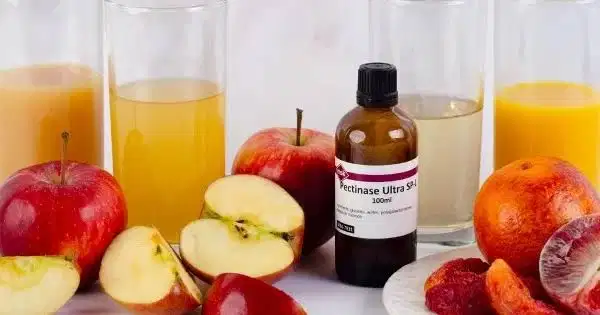
Pectinase is an important industrial enzyme used in fruit juice processing to improve juice extraction, reduce viscosity, enhance filtration, and support clarification. It is widely applied in the processing of apples, grapes, citrus fruits, berries, and other fruit-based raw materials.
For commercial juice manufacturers, pectinase helps address common production challenges associated with pectin, a naturally occurring polysaccharide found in plant cell walls and the middle lamella. By breaking down pectin, the enzyme can improve juice processing efficiency and help manufacturers achieve consistent product quality.
As demand grows for clear juices, fruit concentrates, and high-quality beverage ingredients, pectinase remains a valuable processing aid for food manufacturers seeking improved yields and reliable production performance.
What Is Pectinase?
Pectinase refers to a group of enzymes that break down pectin, a structural carbohydrate present in fruit tissues. Commercial pectinase preparations may contain different enzyme activities, including polygalacturonase, pectin lyase, and pectin methylesterase, depending on the intended application.
These enzymes act on pectin through different mechanisms, helping degrade or modify its structure. The resulting changes can reduce viscosity, facilitate the separation of juice from fruit pulp, and improve the effectiveness of downstream filtration.
Industrial pectinase is commonly produced through microbial fermentation. Its performance depends on the enzyme preparation, fruit composition, temperature, pH, processing time, and the characteristics of the raw material.
Key Applications of Pectinase in Fruit Juice Processing
1. Improved Juice Extraction
One of the principal applications of pectinase is increasing the efficiency of juice extraction from fruit pulp.
Pectin contributes to the structural integrity of fruit tissues and can make juice extraction more difficult. By degrading pectin, the enzyme helps release liquid from the fruit matrix, improving separation during pressing and related extraction operations.
Potential benefits include:
Improved juice recovery from suitable fruit materials
Easier separation of juice from pulp
Reduced viscosity during processing
Better utilisation of raw fruit
Potential reductions in processing time
The actual yield improvement varies with the fruit variety, ripeness, pretreatment, pressing equipment, and enzyme dosage.
2. Juice Clarification and Transparency
Pectinase is widely used to clarify fruit juices by breaking down pectin that contributes to cloud stability and processing difficulties.
After enzymatic treatment, suspended particles can be easier to remove through settling, centrifugation, or filtration, depending on the juice and the overall process.
This application is particularly relevant to clear apple juice, grape juice, and other beverages where visual transparency is an important quality attribute.
Manufacturers must distinguish between clarification and complete removal of all suspended material. Pectinase primarily modifies pectin; additional separation steps may still be required to achieve the desired clarity.
3. Reduced Viscosity and Improved Filtration
Pectin can increase the viscosity of fruit juice and create difficulties during filtration. Pectinase breaks down pectic substances, reducing their contribution to viscosity and making juice easier to handle.
Improved filtration behaviour can support:
Higher filtration throughput under suitable conditions
Reduced filter clogging
More efficient clarification
Easier handling of juice concentrates and intermediate streams
More consistent downstream processing
The benefits depend on the juice composition, filter technology, solids loading, and the enzyme preparation used.
4. Processing Apples and Pears
Apple and pear juice production is a major application area for pectinase. These fruits contain pectic substances that can complicate extraction, clarification, and filtration.
Enzyme treatment helps break down pectin in the fruit mash or extracted juice, depending on the production process. This can improve pressing performance and facilitate the production of clear juice.
For industrial processors, the enzyme treatment must be optimised to balance juice recovery, clarity, flavour retention, and operating costs.
5. Grape and Berry Juice Processing
Pectinase also plays an important role in processing grapes, strawberries, raspberries, blackberries, and other berries.
Pectic substances can make these fruits difficult to press and may contribute to high viscosity. Enzyme treatment can help release juice, improve pressing performance, and facilitate separation of suspended material.
In coloured fruit juices, processors must also consider pigment extraction and stability. Enzyme selection and treatment conditions should be designed to preserve the desired colour, aroma, and flavour characteristics.
6. Citrus Juice and Fruit Preparations
Pectinase is used in selected citrus processing applications, including the treatment of fruit preparations and juice streams where pectin affects viscosity or separation.
However, citrus products vary considerably in their intended characteristics. Some beverages are expected to retain pulp and cloud, while others require reduced viscosity or improved separation.
For this reason, manufacturers should select an enzyme preparation according to the desired product specification rather than applying the same clarification process to every citrus beverage.
Other Food and Beverage Applications
Beyond conventional juice clarification, pectinase has several applications in food processing.
Fruit wine production: Pectinase can improve juice extraction and facilitate clarification during the production of fruit wines, subject to the process design.
Fruit concentrates: By reducing pectin-related viscosity, suitable enzyme treatments can support processing and filtration before concentration.
Fruit purees and preparations: Enzymatic treatment can modify consistency and improve separation or processing performance when a less viscous product is desired.
Plant-based extraction: Pectin-degrading enzymes can assist in releasing liquid or soluble components from selected plant materials.
Enzyme combinations: Pectinase may be combined with cellulases, hemicellulases, or other enzymes to target different components of plant cell walls and improve extraction performance.
These applications require formulation-specific testing because the effects of enzyme combinations can differ from those of pectinase alone.
How Pectinase Improves Juice Quality and Production Efficiency
Pectinase supports juice processing through several related functional effects.
Functional effect | Potential industrial benefit |
|---|---|
Pectin degradation | Easier juice release from fruit tissues |
Reduced pectin-related viscosity | Improved liquid handling |
Improved separation | More efficient clarification |
Better filtration behaviour | Potentially higher throughput |
Modified fruit mash structure | Improved extraction performance |
Reduced processing resistance | Potential operational efficiencies |
These benefits are not automatic. Excessive or unsuitable enzyme treatment can affect product texture, cloud stability, or other quality attributes. Manufacturers should validate enzyme performance under actual production conditions.
Factors Affecting Pectinase Performance
Several variables influence the effectiveness of pectinase in industrial juice production.
Enzyme composition: Different pectinase preparations contain different activities and are designed for specific fruit-processing applications.
Temperature: Each enzyme preparation has a suitable operating temperature range. Excessive heat can reduce enzyme activity.
pH: Fruit acidity affects enzyme performance. A preparation suitable for apple juice may not be optimal for another fruit or processing stream.
Dosage and treatment time: Insufficient treatment may leave excessive pectin, while unnecessary enzyme use can increase costs without delivering additional benefits.
Fruit maturity and composition: Ripeness, variety, storage history, and pectin content influence the response to treatment.
Mixing and contact: Effective distribution of the enzyme throughout the fruit mash or juice is important for consistent processing.
Downstream equipment: Pressing systems, centrifuges, filters, and clarification technologies affect the final performance and economic value of enzyme treatment.
Pilot trials should measure juice yield, viscosity, filtration rate, clarity, colour, sensory quality, and processing costs to identify the most suitable operating conditions.
Quality Control and Regulatory Considerations
Food manufacturers should verify that their pectinase preparation is suitable for the intended food application and complies with the regulations of the destination market.
Important checks include:
Food-grade suitability and permitted use
Declared enzyme activity and dosage recommendations
Certificate of Analysis (COA)
Technical data sheet and applicable Safety Data Sheet (SDS)
Microbiological quality and relevant contaminant specifications
Allergen and production-organism information, where applicable
Storage conditions, shelf life, and batch traceability
Applicable processing-aid and labelling requirements
The legal status and labelling treatment of processing aids can differ between jurisdictions. Manufacturers should consult the relevant food regulations and verify whether specific disclosure requirements apply to their products.
Sourcing Pectinase for Industrial Juice Processing
Selecting the right pectinase supplier is essential for achieving reliable processing performance and consistent juice quality.
Procurement teams should evaluate suppliers against the following criteria:
Application suitability: Confirm whether the enzyme is designed for apple juice, grape juice, berries, citrus, concentrates, or another application.
Enzyme activity: Compare the declared activity and technical performance of different preparations.
Processing compatibility: Verify recommended temperature, pH, dosage, and treatment time.
Technical documentation: Request a COA, technical data sheet, and relevant regulatory documentation.
Technical support: Look for suppliers able to help optimise extraction and clarification processes.
Supply reliability: Assess batch consistency, packaging, storage, delivery schedules, and production capacity.
A well-designed pilot trial can help processors compare enzyme products, estimate potential yield improvements, and calculate the cost per unit of juice produced rather than focusing only on the purchase price of the enzyme.
Market Outlook: Enzymes in Fruit Processing
Food manufacturers continue to seek processing solutions that improve raw-material utilisation, support consistent quality, and reduce operational inefficiencies. Enzymes such as pectinase can contribute to these objectives by improving extraction and simplifying selected clarification operations.
Opportunities exist across fruit juice, beverage concentrates, fruit preparations, and other plant-based processing sectors. However, the commercial value of pectinase depends on measurable process improvements, the cost of enzyme treatment, and the requirements of the final product.
For ingredient suppliers, providing application-specific formulations, reliable technical documentation, and practical process support can help strengthen relationships with industrial food manufacturers.
Key Takeaways
Pectinase is a valuable enzyme in fruit juice processing because it breaks down pectic substances that affect extraction, viscosity, clarification, and filtration. Its applications span apple, pear, grape, berry, citrus, and other fruit-processing operations.
For manufacturers, the best results come from selecting an appropriate enzyme preparation, optimising dosage and operating conditions, and measuring improvements in juice yield, clarity, and production efficiency. Combining technical validation with dependable sourcing can help support consistent product quality and more efficient fruit-processing operations.
Sources
Pectin (E440) CAS: 9000-69-5