
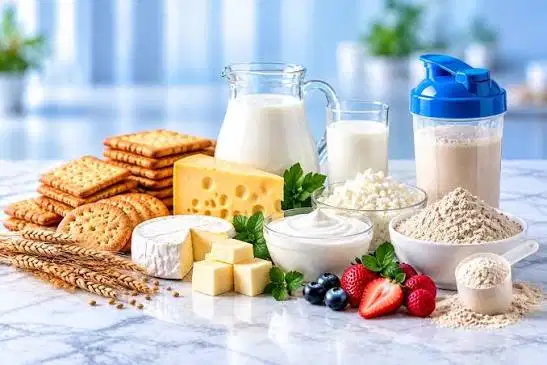
Protease enzymes play a vital role in food manufacturing by breaking down proteins into smaller peptides and amino acids. They are widely used in protein hydrolysis, meat processing, dairy production, baking, flavour development, and the manufacturing of specialised food ingredients.
For industrial food manufacturers, proteases provide a controlled way to modify protein functionality, improve processing efficiency, and develop products with specific nutritional, textural, and sensory characteristics. Their applications range from producing protein hydrolysates for nutritional formulations to tenderising meat and modifying dough properties in commercial baking.
As demand for functional protein ingredients and efficient food-processing technologies continues to grow, protease enzymes remain valuable tools for manufacturers seeking consistent quality and application-specific performance.
What Are Protease Enzymes?
Proteases, also called proteinases or proteolytic enzymes, catalyse the hydrolysis of peptide bonds in proteins. This reaction breaks large protein molecules into smaller peptides and, depending on the enzyme and treatment conditions, free amino acids.
Proteases are classified according to their catalytic mechanisms and the types of peptide bonds they preferentially break. Two broad categories are particularly important:
Endopeptidases: Break peptide bonds within a protein chain, producing smaller peptides.
Exopeptidases: Remove amino acids or short peptide units from the ends of protein chains.
Commercial proteases can be obtained from microbial fermentation, plants, and animal sources. Microbial preparations are widely used in industrial processing because they can be selected for specific activity profiles and operating conditions.
Common examples include microbial alkaline proteases, fungal proteases, papain from papaya, bromelain from pineapple, and animal-derived enzymes such as pepsin.
Key Applications of Protease Enzymes in Food Processing
1. Protein Hydrolysis and Functional Ingredients
Protein hydrolysis is one of the most important applications of protease enzymes. During this process, proteins from sources such as soy, pea, whey, casein, and other food materials are broken down into smaller peptides.
The resulting protein hydrolysates can have different functional properties depending on the protein source, enzyme specificity, degree of hydrolysis, and processing conditions.
Potential applications include:
Protein-enriched beverages and nutritional formulations
Easily dispersible protein ingredients
Specialised food formulations with modified functional properties
Peptide-rich ingredients for food development
Ingredients with adjusted solubility and viscosity
Protease treatment can improve the solubility of certain proteins, although the effect varies by formulation. Excessive hydrolysis may also introduce bitterness, so manufacturers need to balance the desired functionality with sensory quality.
2. Meat Tenderisation
Proteases are widely used to improve the tenderness of selected meat products. Enzymes such as papain and bromelain can break down muscle proteins and connective-tissue components, changing the texture of the meat.
Applications include marinated meat, processed meat products, and selected foodservice preparations.
Potential benefits include improved tenderness, greater consistency between portions, and flexibility in using different meat cuts.
However, the treatment must be carefully controlled. Excessive proteolysis can produce an overly soft or mushy texture and reduce product quality. Enzyme dosage, treatment time, temperature, meat composition, and application method all influence the result.
3. Dairy Processing and Cheese Manufacturing
Proteases have several important functions in dairy processing, particularly in cheese production and the modification of milk proteins.
Rennet enzymes, which contain proteolytic activity, initiate milk coagulation by acting on specific milk proteins. The resulting curd formation is essential to many cheese-making processes.
Other proteases may be used in selected dairy applications to modify protein structure, support cheese ripening, and develop characteristic flavours and textures.
In cheese maturation, controlled protein breakdown contributes to changes in firmness, body, aroma, and taste. Excessive proteolysis, however, may cause undesirable bitterness or structural defects.
Enzyme selection must therefore reflect the cheese variety, milk composition, manufacturing process, and intended maturation profile.
4. Baking and Dough Modification
Protease enzymes are used in commercial baking to modify gluten proteins and influence dough handling properties.
Controlled proteolysis can reduce dough elasticity and resistance to extension, making some doughs easier to sheet, mould, or process. This can be useful in selected biscuit, cracker, wafer, and other bakery formulations.
Potential benefits include:
Reduced dough resistance during sheeting
Improved machinability in suitable formulations
Modified dough extensibility
More consistent processing performance
Proteases must be used carefully in wheat-based products. Excessive enzyme activity can weaken the gluten network, reduce gas retention, and negatively affect bread volume and crumb structure.
For this reason, enzyme selection and dosage should be optimised for the specific bakery application rather than applied uniformly across all dough types.
5. Fish Processing and Seafood Applications
Protease enzymes can help modify fish proteins and support the production of selected seafood ingredients.
Applications include fish protein hydrolysates, flavour ingredients, and processing streams where protein breakdown is desirable. Enzymatic hydrolysis can help recover soluble peptides from suitable fish raw materials and by-products.
The resulting hydrolysates may be used in food formulations, subject to quality, sensory, nutritional, and regulatory requirements.
Because excessive hydrolysis can generate bitterness and unwanted odours, manufacturers should control the reaction and use suitable downstream separation or flavour-management steps.
6. Plant-Based Protein Processing
Plant proteins derived from soy, pea, wheat, and other sources are widely used in meat alternatives, beverages, protein powders, and formulated foods.
Proteases can modify these proteins to influence solubility, viscosity, digestibility-related properties, and flavour.
Depending on the protein source and enzyme preparation, controlled hydrolysis may help improve dispersibility or facilitate the development of specialised ingredients.
However, the results are highly formulation-dependent. Hydrolysis may also reduce gel strength or emulsifying performance, so the enzyme treatment must be matched to the intended product structure.

Protein Hydrolysis: How the Process Works
Industrial protein hydrolysis generally involves several stages.
Raw material preparation: The protein source is prepared and dispersed or dissolved under suitable conditions.
Enzyme selection: A protease is selected according to the protein substrate and the desired peptide profile.
Reaction control: Temperature, pH, dosage, and processing time are adjusted to achieve the target degree of hydrolysis.
Enzyme inactivation: Where required, the reaction is stopped using a validated treatment, commonly involving heat.
Separation and purification: Filtration, centrifugation, concentration, or other operations may be used to obtain the desired ingredient.
Drying and formulation: The hydrolysate may be concentrated, spray-dried, or incorporated into a finished food ingredient.
The degree of hydrolysis is an important process indicator because it reflects the extent to which peptide bonds have been cleaved. It influences peptide size distribution and can affect solubility, viscosity, bitterness, and other functional characteristics.
Other Applications of Protease Enzymes
Beyond the major applications described above, proteases are used in several specialised food-processing operations.
Flavour development: Proteolysis releases peptides and amino acids that can contribute to flavour development or serve as precursors in subsequent reactions.
Protein recovery: Enzymatic treatment can assist in recovering soluble protein fractions from selected food-processing side streams.
Fermented foods: Proteases can contribute to protein breakdown during the manufacture and maturation of certain fermented foods.
Food ingredient modification: Controlled hydrolysis can adjust protein functionality for sauces, soups, beverages, and specialised formulations.
Brewing: Proteolytic enzymes may be used in selected brewing processes to modify proteins and help manage issues such as haze formation, depending on the process design.
Each application requires a suitable enzyme preparation and validated process conditions.
Factors Affecting Protease Performance
Successful protease application depends on several technical variables.
Enzyme specificity: Different proteases act on different peptide bonds and produce different peptide profiles.
Temperature: Each enzyme has an operating range that influences reaction speed and stability.
pH: Acidic, neutral, and alkaline proteases are suited to different processing environments.
Dosage and reaction time: These determine the extent of protein breakdown and influence the cost and functional properties of the final ingredient.
Protein source: Animal, dairy, cereal, and plant proteins respond differently because their structures and amino acid sequences vary.
Degree of hydrolysis: A higher degree of hydrolysis does not always mean better performance. Excessive treatment may create bitterness, weaken gels, or impair emulsification.
Process termination: The method used to stop enzyme activity affects product consistency and the stability of subsequent processing steps.
Manufacturers should evaluate relevant parameters, including peptide profile, degree of hydrolysis, solubility, texture, sensory characteristics, and microbial quality.
Quality Control and Regulatory Considerations
Food manufacturers should confirm that protease preparations are suitable for their intended application and comply with the requirements of the destination market.
Important quality checks include:
Food-grade suitability and permitted use
Declared enzyme activity and recommended dosage
Certificate of Analysis (COA)
Technical data sheet and applicable Safety Data Sheet (SDS)
Microbiological specifications and relevant contaminant limits
Production organism and allergen-related information, where applicable
Storage conditions, shelf life, and batch traceability
Applicable enzyme authorisation and ingredient-labelling requirements
Protein hydrolysates also require application-specific assessment. Depending on their source and manufacturing process, manufacturers may need to evaluate allergen status, residual components, sensory properties, and nutritional specifications.
Protease treatment should not be assumed to eliminate food allergens or make a product suitable for people with food allergies. Any such claim requires appropriate evidence and regulatory review.
Sourcing Protease Enzymes for Industrial Food Processing
Selecting a suitable protease supplier requires both technical evaluation and commercial assessment.
Define the application: Specify whether the enzyme is intended for protein hydrolysis, meat tenderisation, cheese production, baking, seafood, or plant-protein processing.
Identify the required enzyme profile: Assess the source, specificity, pH range, temperature range, and declared activity.
Request technical documentation: Review the COA, technical data sheet, and applicable regulatory documents.
Conduct pilot trials: Compare enzyme preparations using measurable criteria such as degree of hydrolysis, solubility, texture, and sensory quality.
Calculate total processing costs: Consider dosage, treatment time, energy use, downstream separation, yield, and product quality.
Assess supply reliability: Evaluate production capacity, batch consistency, packaging, delivery schedules, and storage requirements.
A technically suitable enzyme may provide better overall value than a lower-priced alternative if it achieves the required result with more predictable processing and fewer quality defects.
Market Outlook: Protease Enzymes in Food Manufacturing
Protease demand is supported by the continued development of protein-rich foods, specialised nutritional ingredients, processed meat products, dairy applications, and plant-based formulations.
Food manufacturers are increasingly interested in enzymes that offer controlled protein modification, predictable performance, and flexibility across different raw materials.
For enzyme suppliers, opportunities include application-specific protease preparations, technical support for hydrolysis optimisation, and solutions that help manufacturers manage bitterness and improve functional performance.
Commercial success depends on demonstrating measurable benefits while meeting food safety, quality, and regulatory requirements.
Key Takeaways
Protease enzymes are essential tools for protein hydrolysis and food processing. They break proteins into smaller peptides and amino acids, supporting applications in nutritional ingredients, meat tenderisation, dairy processing, baking, seafood, and plant-based protein development.
Their performance depends on enzyme specificity, temperature, pH, dosage, protein source, and degree of hydrolysis. Manufacturers can achieve more consistent results by selecting application-specific preparations, validating processing conditions, and working with reliable suppliers.
Sources
Corn Gluten Meal (60% Min Protein) - United States CAS: 66071-96-3