
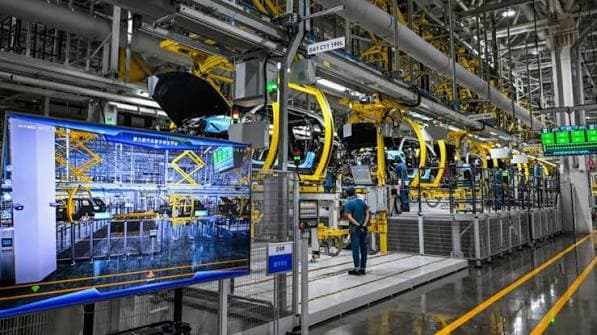
China's official manufacturing PMI remained below the 50-point expansion threshold for a second consecutive month in August 2026, although the reading improved from July's 49.2 to 49.8. The result was better than the roughly 49.6 consensus expected by economists, but it still indicated contraction in manufacturing activity.
That makes the current PMI trajectory more nuanced than a simple deterioration story: manufacturing conditions improved in August, but the sector has yet to return to expansion.
The Streak Is Shorter Than Initially Expected
The latest data changes the ranking metric considerably.
China's official manufacturing PMI was below 50 in January (49.3), February (49.0), July (49.2) and August (49.8), while March through June remained at or above the threshold.
The current uninterrupted contraction streak is therefore two months, not four.
Month | Manufacturing PMI | Status |
|---|---|---|
January 2026 | 49.3 | Contraction |
February 2026 | 49.0 | Contraction |
March 2026 | 50.4 | Expansion |
April 2026 | 50.3 | Expansion |
May 2026 | 50.0 | Neutral |
June 2026 | 50.3 | Expansion |
July 2026 | 49.2 | Contraction |
August 2026 | 49.8 | Contraction |
The important intelligence signal is therefore not the number of months below 50 across the year, but whether July and August mark the beginning of another sustained contraction cycle.
August Delivered a Partial Improvement
The headline PMI improved by 0.6 points in August. More importantly, several underlying manufacturing indicators moved back into expansion.
Production increased to 50.4, while new orders rose to 50.6 and new export orders reached 50.1. This suggests that manufacturing activity was supported by improving production and external demand even though the overall PMI remained below 50.
This creates a significant divergence between China's domestic economy and some export-oriented manufacturing segments.
Export Demand Is Providing a Cushion
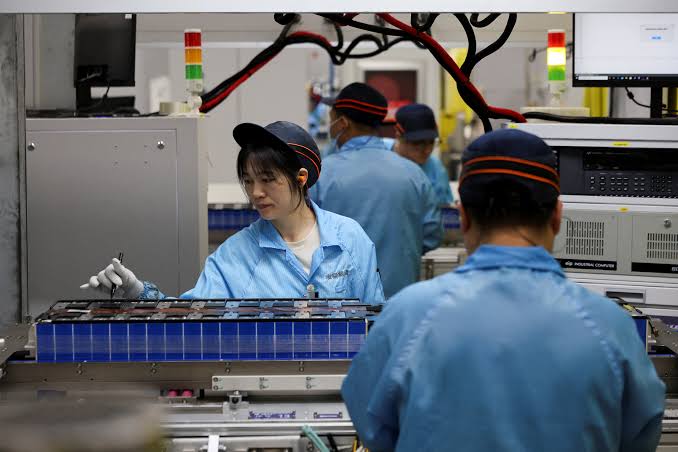
One of the strongest features of the August data was the improvement in export-related activity. Reuters reported that stronger exports, particularly in high-tech manufacturing and AI-related areas, helped support factory activity.
That matters for chemical and industrial companies because China's manufacturing demand is an important driver of global commodity consumption. Stronger export manufacturing can support demand for plastics, electronic chemicals, industrial gases, specialty chemicals and other upstream inputs even when domestic consumption remains weak.
Domestic Demand Remains the Weak Link
The improvement in factory activity should not be interpreted as a broad-based economic recovery.
China's non-manufacturing PMI remained at 49.0 in August, while weak domestic demand and continued property-sector weakness remained important constraints on the broader economy. Reuters also noted that consumer-oriented and energy-intensive industries continued to struggle.
This distinction is critical for industry intelligence: China can simultaneously have strong export manufacturing in selected sectors and weak domestic industrial demand.
High-Tech Manufacturing Is Outperforming Traditional Industry
The composition of August's improvement is another important signal. High-tech and equipment manufacturing continued to outperform, with technology-related production benefiting from global AI and semiconductor demand. At the same time, traditional consumer-facing and high-energy-consuming industries remained under pressure.
For chemical producers, this suggests that demand recovery may remain highly uneven.
Electronic chemicals, advanced materials and semiconductor-linked inputs may experience stronger demand than chemicals primarily exposed to construction, property and traditional consumer markets.
Why the PMI Matters for Global Chemical Markets
China accounts for a substantial share of global chemical production and consumption, so PMI trends provide an important early indicator for commodity markets.
A prolonged manufacturing contraction could reinforce:
weaker domestic chemical demand,
pressure on operating rates,
inventory accumulation,
aggressive export pricing,
lower margins for commodity producers, and
additional pressure on overseas producers competing with Chinese exports.
Conversely, a sustained return above 50 would provide a stronger signal that China's industrial demand is broadening.
The August figure does not yet provide that confirmation.
How the Current Trajectory Ranks
From an industry-intelligence perspective, China's 2026 PMI trajectory can currently be ranked as follows:
1. Two-month current contraction streak — July and August remain below 50.
2. Weak domestic-demand signal — services and consumer-facing sectors continue to show softness.
3. Export manufacturing resilience — external demand is cushioning the broader slowdown.
4. High-tech divergence — AI, semiconductor and advanced manufacturing segments are performing better than traditional industries.
5. Recovery uncertainty — the rise from 49.2 to 49.8 is encouraging, but one month of improvement does not establish a sustained recovery.
The Bigger Intelligence Question
The key question heading into September is no longer simply "How many consecutive months will China's PMI remain below 50?"
It is whether August's improvement represents the beginning of a return to expansion or merely a temporary stabilization around the contraction threshold.
A September reading above 50 would immediately break the current two-month streak and strengthen the argument that July represented a temporary low. Another sub-50 reading, however, would turn the current two-month contraction into a more meaningful industrial trend.
For global chemical markets, that distinction could be significant. A genuine Chinese manufacturing recovery would provide support for commodity demand and potentially help absorb some of the excess capacity currently weighing on petrochemicals and basic chemicals. Continued weakness, particularly alongside China's enormous new production capacity, would increase the probability of sustained export pressure.
The Intelligence Takeaway
China's official manufacturing PMI is currently in its second consecutive month below 50, but August's rise to 49.8 shows that the contraction is not deepening at the same pace as July.
The most important signal is the divergence underneath the headline: export-oriented and high-tech manufacturing are showing resilience, while domestic-demand-sensitive and energy-intensive sectors remain weaker.
For chemical and industrial markets, September's PMI will therefore be more important than the August number alone. A move above 50 would suggest that the latest downturn is fading; another sub-50 reading would make the current contraction streak increasingly relevant to global supply-demand expectations.
Polyethylene Glycol (200) - China CAS: 25322-68-3