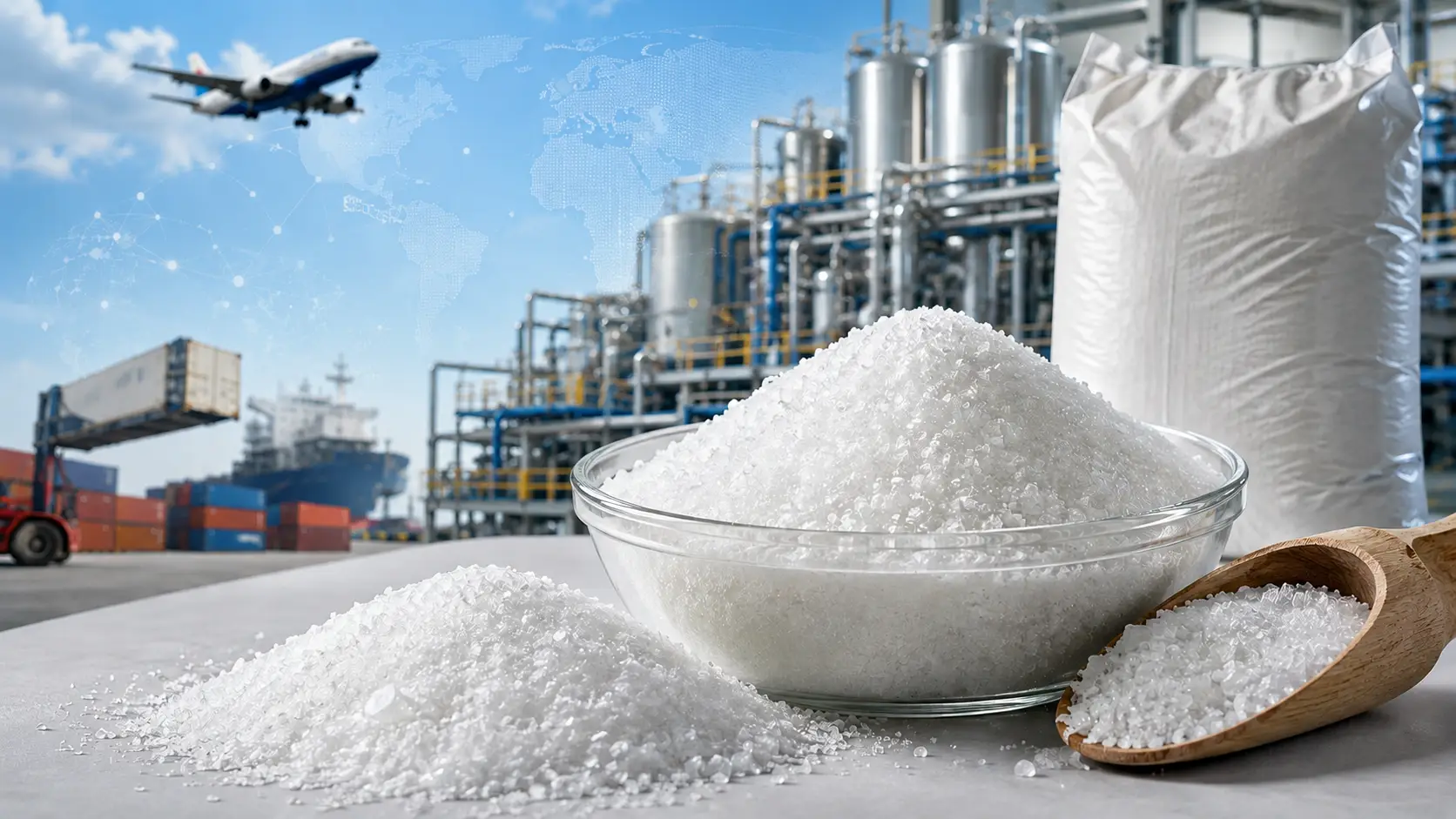

Sodium bicarbonate, commonly called baking soda, is a versatile inorganic compound used across food processing, animal feed, pharmaceuticals, detergents and industrial manufacturing. Its chemical formula is NaHCO₃, and its buffering, alkalinity and carbon dioxide release properties make it valuable across very different production processes.
For B2B buyers, sourcing sodium bicarbonate requires more than comparing quoted prices. The intended application determines the appropriate grade, specification, documentation, packaging and regulatory requirements, while freight and supplier reliability influence the final delivered cost.
A strong sourcing strategy starts by matching product quality to end use, then evaluating suppliers based on consistency, availability, logistics and commercial terms. This approach can help importers, distributors and manufacturers reduce supply interruptions while maintaining competitive procurement costs.
Sodium Bicarbonate Applications Across Major Industries
Sodium bicarbonate supports a wide range of commercial applications because manufacturers can use its chemical and physical properties in different ways. Demand comes from both regulated industries and general industrial users.
Key application areas include:
Food and beverage: Manufacturers use sodium bicarbonate as a leavening component, acidity regulator and processing ingredient in suitable formulations.
Animal feed: Feed manufacturers use appropriate grades where sodium supply and buffering characteristics support nutritional formulations.
Pharmaceuticals: Suitable pharmaceutical grades can serve specific formulations and acid-neutralizing applications.
Personal care: Formulators may incorporate sodium bicarbonate into selected oral care, cleansing and personal care products.
Detergents and cleaning products: Its alkalinity and physical properties make it useful in selected cleaning formulations.
Chemical processing: Manufacturers can use sodium bicarbonate for pH adjustment, neutralization and controlled carbon dioxide generation.
Environmental applications: Appropriate grades can support selected treatment processes where alkalinity adjustment or contaminant control is required.
The application determines the purchasing specification. A food processor and an industrial chemical manufacturer should not automatically purchase the same commercial grade simply because both require sodium bicarbonate.
Food Industry Demand for Sodium Bicarbonate
Food processing represents one of the most established markets for sodium bicarbonate. Bakeries and food manufacturers use it in formulations where controlled carbon dioxide generation helps produce the desired texture and structure.
Food buyers typically pay close attention to product purity and consistency. Variations in particle characteristics or chemical composition can affect processing performance, particularly in standardized recipes produced at high volume.
Procurement teams should evaluate:
Applicable food-grade specifications
Assay and impurity limits
Physical appearance and particle characteristics
Certificate of analysis availability
Packaging integrity
Traceability and batch consistency
Documentation required by the destination market
For international sourcing, buyers should also confirm that supplier documentation matches the regulations applicable to their specific market and intended food use.
Pharmaceutical and Healthcare Applications
Pharmaceutical manufacturing creates a more demanding procurement environment because material quality and documentation can directly affect formulation and regulatory processes.
Sodium bicarbonate can serve in selected pharmaceutical formulations because of its alkalizing and acid-neutralizing properties. Manufacturers may use suitable material in products where controlled pH or acid-base characteristics form part of the formulation requirement.
Pharmaceutical buyers often assess:
Quality: The material should meet the agreed specification consistently across batches.
Documentation: Buyers may require certificates of analysis, technical information, safety documentation and other quality records.
Traceability: Clear batch identification and supply-chain records can simplify quality management.
Supplier qualification: Pharmaceutical companies generally need a more structured approval process before adding a new raw material supplier.
Price remains important, but pharmaceutical procurement usually places greater emphasis on reliable quality and documentation than on achieving the lowest initial quotation.
Animal Feed and Agricultural Uses
Sodium bicarbonate also has an established role in animal nutrition. Feed manufacturers can use suitable feed-grade material where sodium supplementation and buffering characteristics form part of the formulation strategy.
Feed buyers generally focus on consistent composition, appropriate grade documentation and dependable availability. Large feed producers also need suppliers that can support recurring volumes according to established production schedules.
For distributors serving the feed sector, packaging and shipment flexibility can become important competitive factors. Some customers need large-volume deliveries while others require smaller, more frequent replenishment.
A supplier that understands these different purchasing models can offer more practical solutions than one that simply provides a standard commodity quotation.
Industrial and Chemical Applications
Industrial users purchase sodium bicarbonate for functions that differ significantly from food or pharmaceutical applications. Its chemical behavior can make it useful for pH adjustment, neutralization, gas generation and selected manufacturing processes.
Cleaning product manufacturers may use sodium bicarbonate in formulations where alkalinity or controlled abrasive characteristics provide a functional benefit. Chemical processors can also use it where a controlled reaction or neutralization step requires a bicarbonate-based raw material.
Other potential industrial applications include:
Detergent and cleaning formulations
Selected water and environmental treatment processes
Chemical manufacturing
Fire-extinguishing formulations
Paper and textile processing
Laboratory and technical applications
Industrial surface and process treatments
Industrial buyers should define the process requirement before requesting quotations. This helps suppliers identify an appropriate grade and reduces the risk of purchasing material that does not perform as required.
Choosing the Right Sodium Bicarbonate Grade
One of the most important sourcing decisions involves grade selection. The commercial term "sodium bicarbonate" does not by itself define whether a product is suitable for food, feed, pharmaceutical or industrial use.
Buyers should specify the intended application in the inquiry and purchase order. They should also request the relevant technical specification rather than relying only on a generic product name.
Important parameters may include:
Chemical assay
Moisture
Particle size distribution
Bulk density
Appearance
Impurity limits
Packaging format
Storage requirements
Batch and traceability information
A supplier should provide a certificate of analysis that corresponds to the agreed specification. Buyers can then compare quotations on an equivalent technical basis.
How B2B Buyers Should Evaluate Suppliers
Supplier selection should combine technical qualification with commercial evaluation. A supplier offering the lowest unit price may not provide the best overall value if inconsistent quality, long lead times or inadequate documentation create additional costs.
A practical supplier assessment should cover:
Product capability: Confirm that the supplier can consistently provide the required grade and specification.
Production capacity: Check whether the supplier can support the expected annual or monthly volume.
Export experience: International buyers should consider the supplier's experience with export documentation and destination-market requirements.
Packaging options: Confirm whether the supplier can provide the required bag size, pallet configuration or bulk shipment format.
Lead time: Compare production schedules and realistic shipping timelines rather than relying only on quoted availability.
Commercial terms: Evaluate payment conditions, minimum order quantities, Incoterms and quotation validity.
Communication: Responsive suppliers can resolve documentation, shipment and quality questions more efficiently.
Sodium Bicarbonate Sourcing and Total Landed Cost
The purchase price represents only one component of the total procurement cost. International buyers should calculate the expected landed cost before comparing competing suppliers.
A useful framework is:
Total landed cost = product price + freight + insurance + port charges + duties and taxes + handling + inland transportation
Container utilization can also influence the final cost per tonne. Packaging weight, pallet requirements and loading efficiency may affect how much material a buyer can transport in each shipment.
Buyers should request quotations using comparable Incoterms and shipment quantities. Comparing one supplier's FOB quotation with another supplier's delivered quotation can produce a misleading price comparison.
Currency movements can also affect procurement budgets when suppliers invoice in US dollars while buyers sell finished products in local currencies.
Packaging, Storage and Logistics Considerations
Sodium bicarbonate requires appropriate packaging and storage to maintain product quality throughout the supply chain. Moisture exposure can affect handling and product condition, making packaging integrity an important consideration during international transportation.
B2B buyers may select packaging according to their manufacturing process, warehouse capacity and shipment volume. Common commercial approaches include smaller bags for distribution and larger formats for industrial users.
Procurement teams should confirm:
Bag material and size
Pallet configuration
Container loading quantity
Protection against moisture
Storage recommendations
Shipping documentation
Expected transit time
Destination-port handling requirements
Clear logistics planning can prevent avoidable delays after the purchase order has already been issued.
Market Opportunities for Traders and Distributors
Sodium bicarbonate offers chemical traders several routes to market because multiple industries use the same core chemical for different purposes. Food processors, feed manufacturers, pharmaceutical companies, cleaning-product producers and industrial users can all represent potential customer segments.
Traders can create additional value by matching customers with the correct grade and shipment format. Product knowledge becomes particularly important when customers require application-specific documentation or recurring international supply.
Distributors can also differentiate themselves through inventory availability and shorter delivery cycles. Holding regional stock can help customers avoid the longer lead times associated with direct international procurement.
For exporters, transparent specifications and clear commercial terms can make supplier evaluation easier for overseas buyers. A strong B2B offer should communicate product grade, quality parameters, packaging, minimum order quantity, shipment options and documentation requirements.
The Bottom Line for Sodium Bicarbonate Buyers
Sodium bicarbonate remains an important B2B chemical because its functional properties support applications across food, feed, pharmaceuticals, personal care, cleaning and industrial processing. This diverse demand base creates opportunities for manufacturers, traders, distributors and importers.
For procurement teams, the strongest sourcing strategy begins with application-specific specifications and continues through supplier qualification, documentation review and landed-cost analysis. The lowest quotation is not necessarily the lowest procurement cost when quality inconsistencies or delivery problems create downstream expenses.
Buyers that maintain reliable supplier relationships, compare equivalent specifications and develop alternative sourcing channels can build a more resilient sodium bicarbonate procurement program. Ready to source Sodium Bicarbonate from verified global suppliers? Explore competitive offers on our platform today.
Sodium Bicarbonate Food Grade (E500(ii)) CAS: 144-55-8