Explore our network of country and industry based websites to access localized information, product offerings, and business services across our group.
Log in to start sending quotation requests for any product.
Don't have an account? Sign Up Here
Home Global Cashew Supply Chain Market: Trends, Risks, and Growth Outlook
Trade Insights | Supply Chain | 24 April 2026
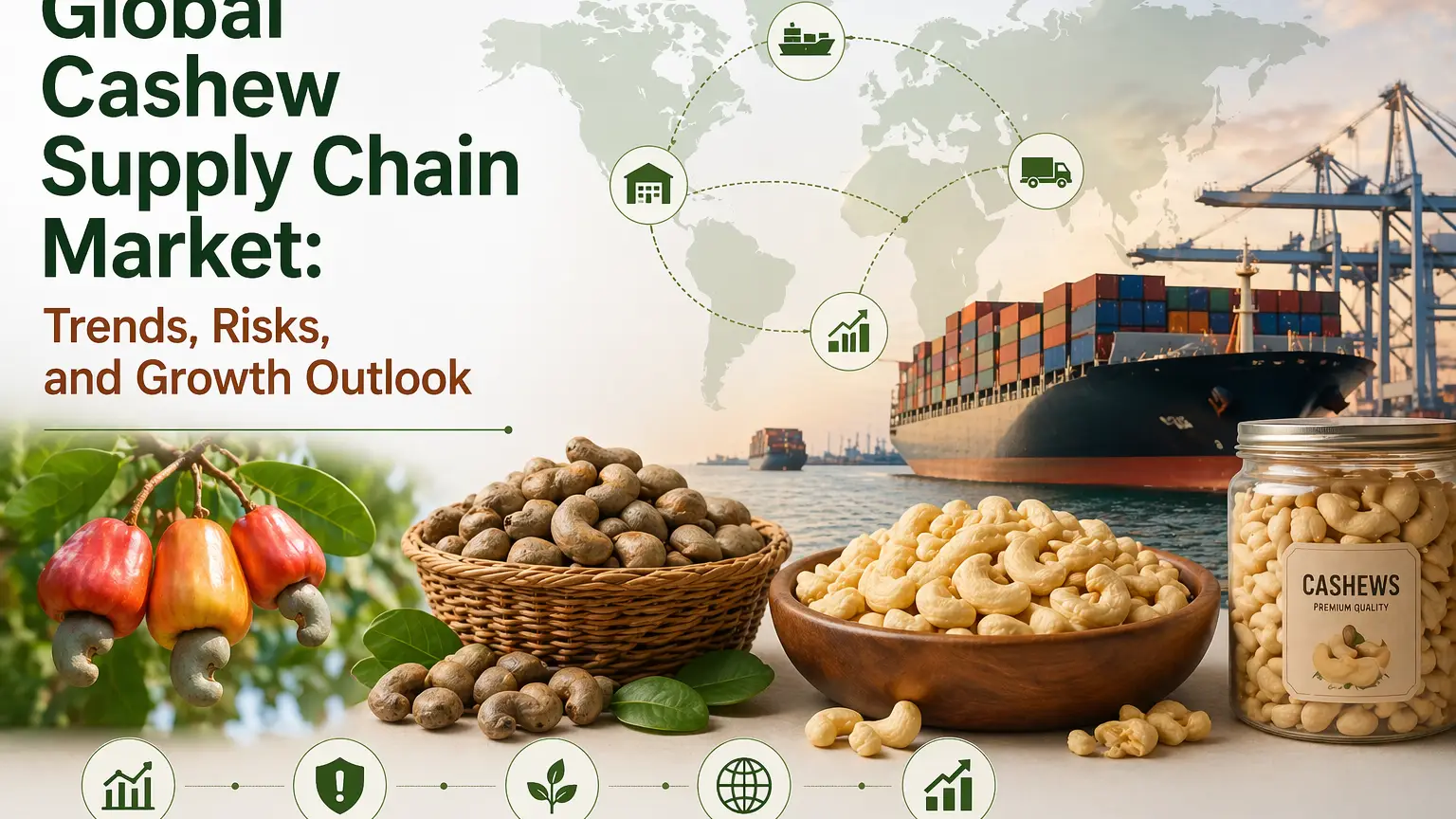
Introduction to the Cashew Supply Chain Market
Geographic Imbalance and Production Concentration
Logistics Volatility and Trade Dependencies
Processing Hubs and Value-Added Transformation
Climate Risk and Supply Chain Resilience
Conclusion
The global cashew supply chain market in 2026 is evolving into a complex, high-value ecosystem shaped by agricultural dependency, industrial processing, and international trade dynamics. Demand for cashew kernels continues to expand across snack foods, plant-based dairy alternatives, and specialty ingredients, pushing the market toward steady growth of nearly 6–7% CAGR in the coming decade .
However, this growth is accompanied by structural inefficiencies and supply risks. The industry operates through a geographically fragmented model, where raw material production, processing, and consumption are dispersed across continents. As a result, supply chain resilience, rather than cost alone, is becoming the defining factor for global buyers.
One of the most critical characteristics of the cashew supply chain is its geographic imbalance. West Africa dominates raw cashew nut production, with countries like Côte d’Ivoire and Ghana supplying a significant share of global output. Meanwhile, Asia—particularly Vietnam and India—controls the majority of processing capacity .
This separation creates a dual-layer supply chain where raw materials must travel long distances before value addition occurs. Such dependency increases exposure to disruptions at both the agricultural and logistics levels. Even minor fluctuations in harvest volumes or export conditions in Africa can significantly impact processing operations and global pricing structures.
Additionally, only a fraction of raw cashew weight—around 20–25%—is converted into kernels, highlighting the importance of efficient sourcing and yield optimization in maintaining profitability .
The cashew trade is heavily reliant on global shipping routes, making it vulnerable to freight cost fluctuations, port congestion, and geopolitical disruptions. The long-distance movement of raw nuts from Africa to Asia introduces logistical complexity and cost variability, which directly affects final product pricing.
Price spreads across the value chain are substantial. Raw cashew nuts may trade between USD 1,000–1,500 per metric ton, while processed kernels can reach up to USD 6,500 per metric ton in export markets . These margins illustrate how logistics, processing, and reliability significantly influence profitability.
As a result, procurement strategies are shifting. Buyers in Europe and North America increasingly favor long-term contracts and supplier diversification to mitigate risk, rather than relying on spot purchasing in volatile markets.
Processing capabilities are now a key competitive differentiator in the cashew market. Vietnam leads with advanced mechanization, including optical sorting and automated shelling, allowing for high efficiency and consistent output. India, while still partially reliant on labor-intensive methods, is gradually modernizing its infrastructure to remain competitive .
A notable trend is the shift toward value-added products. Exporters are moving beyond bulk kernels to offer roasted, flavored, and retail-ready cashew products. This “premiumization” strategy enables higher margins and strengthens brand positioning in global markets.
At the same time, processing innovation is helping reduce waste, improve grading accuracy, and meet stricter international quality standards—factors increasingly demanded by global food manufacturers.
Climate variability is emerging as a long-term threat to the stability of the cashew supply chain. Irregular rainfall, droughts, and temperature fluctuations directly impact crop yields and quality in major producing regions.
Recent data indicates that global cashew output has been affected by weather disruptions, contributing to supply volatility and price fluctuations . Over the past decade, raw cashew prices have shown significant variability, reflecting the sector’s sensitivity to environmental conditions .
To address these challenges, industry stakeholders are investing in climate-resilient farming practices, improved irrigation systems, and diversified sourcing strategies. Digital traceability and closer relationships with farmers are also becoming essential tools for ensuring consistent supply and quality assurance.
The cashew supply chain market is transitioning from a fragmented commodity system into a more structured and value-driven global network. While demand continues to rise, the industry must navigate geographic imbalances, logistics volatility, processing constraints, and climate risks.
In this evolving landscape, partnering with experienced global sourcing providers becomes increasingly important. Companies like Tradeasia International offer integrated solutions that support procurement stability, supply diversification, and industrial growth across multiple sectors. By leveraging reliable networks and market expertise, businesses can better adapt to the complexities of the modern cashew supply chain.
Sources:
We're committed to your privacy. Tradeasia uses the information you provide to us to contact you about our relevant content, products, and services. For more information, check out our privacy policy.


 English
 Indonesian
 简体字
简体字
 العربية
 Español
 Français
 Português
 日本語
日本語
 한국어
한국어
 Tiếng Việt



















