Explore our network of country and industry based websites to access localized information, product offerings, and business services across our group.
Log in to start sending quotation requests for any product.
Don't have an account? Sign Up Here
Home Supply Chain Market of Fumaric Acid in 2026: Strategic Industry Outlook
Trade Insights | Supply Chain | 16 April 2026
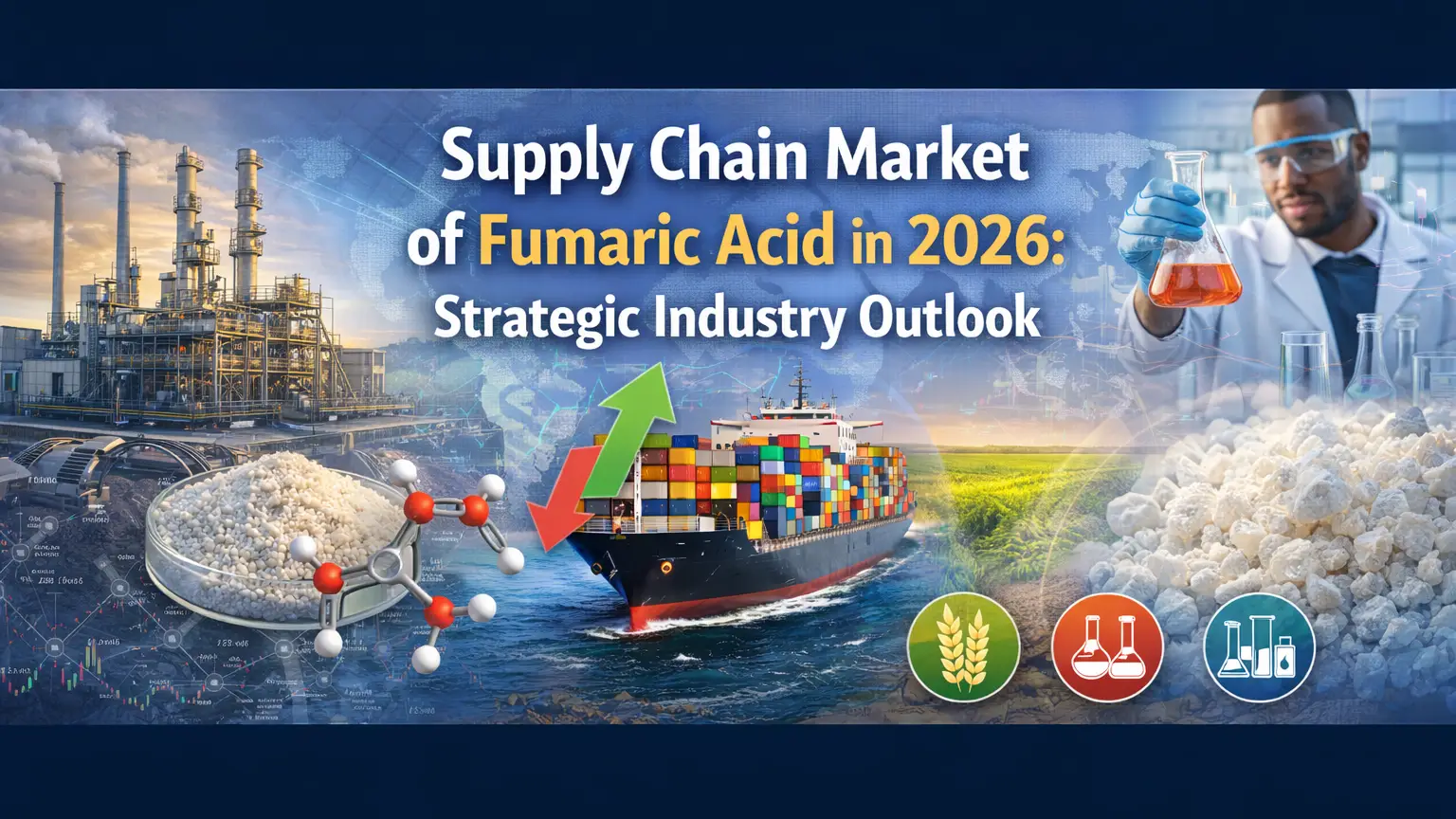
The fumaric acid supply chain in 2026 reflects a mature but increasingly strategic segment of the global organic chemicals industry. Widely used in food acidulants, unsaturated polyester resins, and pharmaceutical intermediates, fumaric acid demand is closely tied to industrial production cycles and food processing growth. Recent market analyses indicate steady expansion driven by construction materials and processed food consumption, while supply chains are becoming more regionalized due to cost, regulatory, and geopolitical pressures affecting chemical trade flows.
A defining structural challenge in the fumaric acid supply chain is its dependence on maleic anhydride, a petrochemical derivative. This linkage exposes producers to crude oil price fluctuations and refinery output cycles. In 2026, producers are increasingly adopting integrated sourcing strategies to stabilize input costs and secure long-term contracts. This upstream vulnerability has also encouraged diversification into bio-based production pathways, although petrochemical routes still dominate commercial volumes due to scale advantages and cost efficiency.
Global production remains heavily concentrated in Asia-Pacific, particularly China and select Southeast Asian manufacturing hubs. This concentration has created efficient low-cost supply clusters but also increased exposure to trade policy shifts and shipping disruptions. As a result, North American and European buyers are gradually shifting toward dual-sourcing strategies and regional stockpiling to mitigate supply risks. Market studies highlight that supply reliability and localized distribution networks are now as important as price competitiveness in procurement decisions.
The 2026 supply chain landscape is increasingly shaped by regulatory compliance and logistics resilience. Food-grade fumaric acid, in particular, requires strict purity standards and documentation, making traceability a critical factor in supplier selection. At the same time, global freight volatility and port congestion risks continue to influence lead times and inventory strategies. Companies are responding by investing in regional warehousing, digital tracking systems, and compliance-focused quality control frameworks to maintain uninterrupted supply to downstream industries.
On the demand side, the strongest pull continues to come from food and beverage manufacturing and unsaturated polyester resin (UPR) applications. Food processors rely on fumaric acid for its stability and acidity control, while the construction and automotive sectors use it in resin systems for durability and corrosion resistance. This dual-sector demand structure creates a stable baseline consumption pattern, supporting long-term supply chain predictability even during cyclical industrial slowdowns.
The fumaric acid supply chain in 2026 is defined by a balance between stable end-use demand and increasingly complex sourcing dynamics. While demand remains anchored in food processing and industrial resins, supply-side risks tied to feedstock dependence, regional concentration, and logistics volatility are reshaping procurement strategies worldwide. The shift toward resilience, compliance, and regionalization is expected to intensify as buyers prioritize continuity over cost optimization alone.
From a strategic standpoint, this evolving landscape opens opportunities for integrated suppliers capable of delivering consistent quality, geographic flexibility, and regulatory assurance. In this context, Tradeasia International continues to position itself as a global chemical distribution partner, offering reliable sourcing networks, streamlined logistics solutions, and consistent supply continuity for industrial buyers navigating an increasingly complex fumaric acid value chain.
Sources :
We're committed to your privacy. Tradeasia uses the information you provide to us to contact you about our relevant content, products, and services. For more information, check out our privacy policy.


 English
 Indonesian
 简体字
简体字
 العربية
 Español
 Français
 Português
 日本語
日本語
 한국어
한국어
 Tiếng Việt



















