Explore our network of country and industry based websites to access localized information, product offerings, and business services across our group.
Log in to start sending quotation requests for any product.
Don't have an account? Sign Up Here
Home How Geopolitics Impacts the Potassium Benzoate Supply Chain Worldwide
Trade Insights | Supply Chain | 14 May 2026
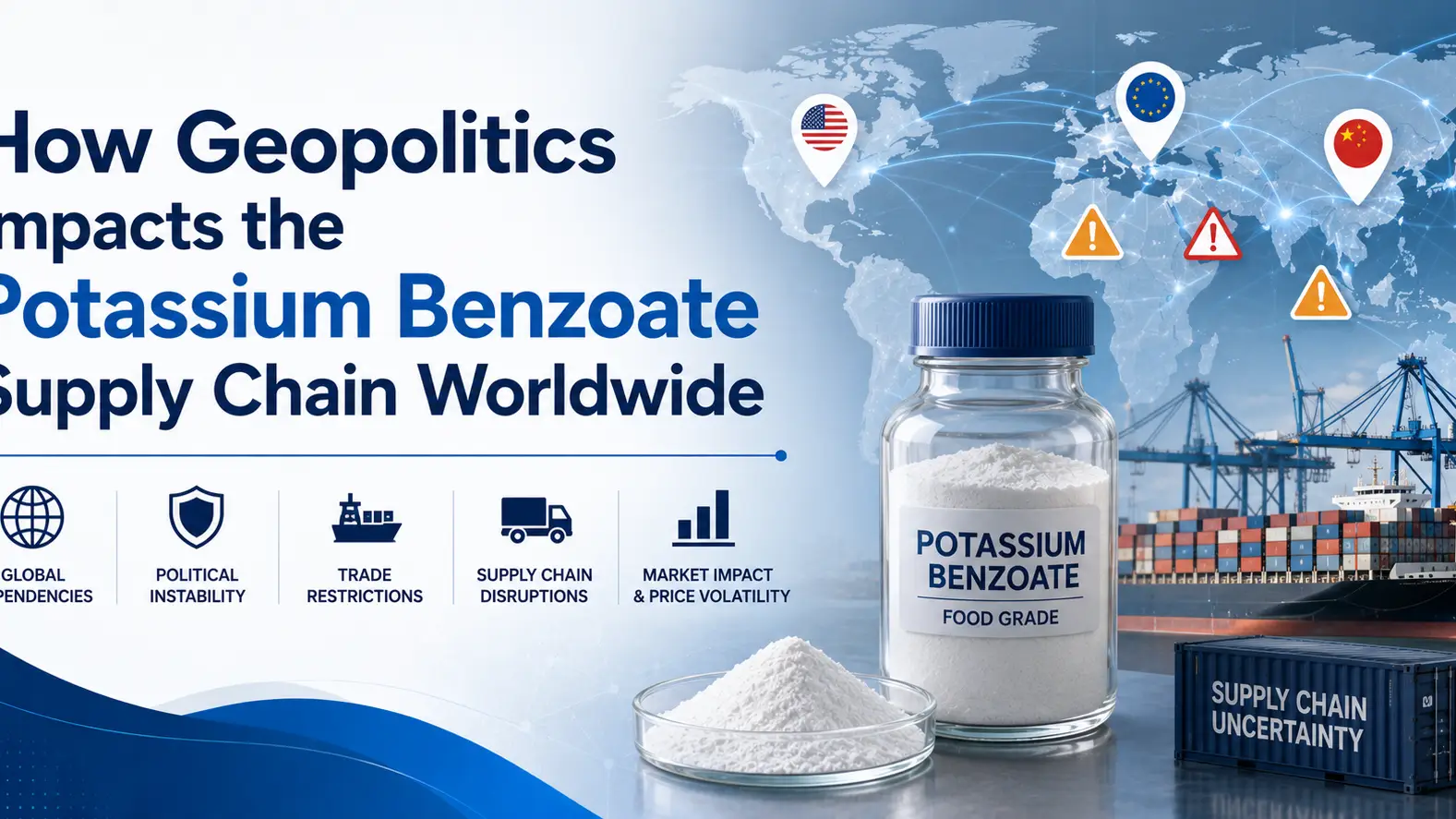
The global potassium benzoate market, a critical preservative used across food and beverage industries, is deeply embedded in a geopolitically sensitive chemical supply chain. Because it is derived from benzoic acid and ultimately linked to petrochemical feedstocks such as toluene, even minor political or trade disruptions can ripple across continents. In today’s interconnected economy, geopolitical tensions, energy policies, and shipping constraints increasingly dictate not only pricing but also availability and production stability of this widely used additive.
At the core of potassium benzoate production lies benzoic acid, which is primarily synthesized from toluene, a petroleum-derived feedstock. This dependency makes the supply chain highly sensitive to crude oil price fluctuations and refinery output decisions. When oil markets tighten or production shifts due to geopolitical sanctions or OPEC+ decisions, cost pressures quickly cascade downstream. As a result, potassium benzoate pricing is indirectly tied to global energy politics and hydrocarbon trade flows.
A significant share of global benzoic acid and potassium benzoate production is concentrated in Asia, particularly China and India, where large-scale chemical manufacturing clusters dominate output. While this concentration improves efficiency, it also creates systemic vulnerability. Environmental inspections, regulatory crackdowns, or localized political disruptions in these regions can immediately reduce global supply availability, creating shortages in import-dependent markets such as Europe and the Middle East.
International trade policies increasingly influence chemical flows. Tariffs, export controls, and evolving chemical safety regulations in key economies reshape sourcing strategies for potassium benzoate buyers. For example, stricter environmental compliance standards in China have periodically reduced operating rates at benzoic acid facilities, tightening global supply conditions. Such policy-driven disruptions highlight how governance frameworks can directly affect industrial chemical continuity.
Global logistics corridors are another critical geopolitical pressure point. The chemical supply chain relies heavily on maritime trade routes such as the Suez Canal and the Red Sea passage. Any disruption—whether due to regional conflict, piracy risks, or port congestion—can extend delivery timelines and increase freight costs. These delays not only strain inventory systems but also amplify price volatility for downstream manufacturers relying on just-in-time procurement models.
Energy markets act as the transmission belt between geopolitics and chemical pricing. Natural gas shortages, refinery constraints, or sanctions on oil-producing nations can elevate production costs for aromatics like toluene. These cost increases propagate through benzoic acid production and ultimately raise potassium benzoate prices. This interconnected structure means that chemical buyers must continuously monitor global energy policy shifts alongside raw material availability.
In response to geopolitical uncertainty, manufacturers and distributors are increasingly diversifying sourcing strategies. Companies are expanding supplier networks across multiple regions, investing in inventory buffers, and forming long-term contracts to reduce exposure to spot market volatility. Digital supply chain tracking and predictive procurement analytics are also becoming essential tools to anticipate disruptions and maintain continuity in potassium benzoate availability.
Geopolitics has become a defining force in the potassium benzoate supply chain, influencing everything from raw material costs to global distribution stability. As trade tensions, energy shifts, and logistical disruptions continue to evolve, businesses must prioritize resilience and diversification to safeguard operations.
In this complex environment, working with integrated chemical distributors becomes essential. Companies like Tradeasia International serve as global solution providers, enabling manufacturers to secure consistent access to potassium benzoate and related chemical intermediates through diversified sourcing networks and efficient logistics management.
We're committed to your privacy. Tradeasia uses the information you provide to us to contact you about our relevant content, products, and services. For more information, check out our privacy policy.


 English
 Indonesian
 简体字
简体字
 العربية
 Español
 Français
 Português
 日本語
日本語
 한국어
한국어
 Tiếng Việt