Explore our network of country and industry based websites to access localized information, product offerings, and business services across our group.
Log in to start sending quotation requests for any product.
Don't have an account? Sign Up Here
Home Potato Starch Supply Chain Market Trends, Risks and Growth
Trade Insights | Supply Chain | 13 March 2026
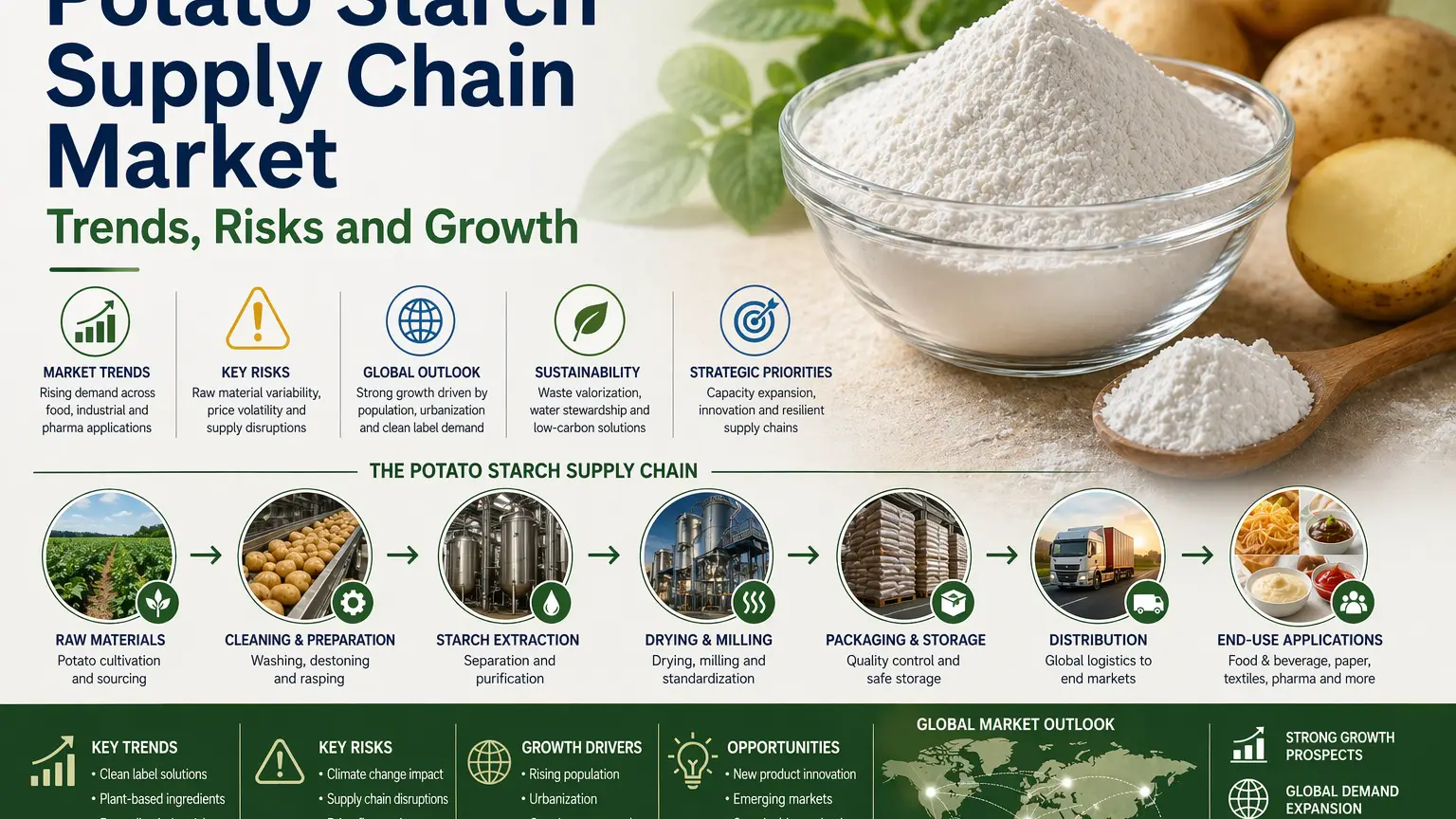
The global potato starch market in 2026 is undergoing a structural transformation driven by supply chain disruptions, evolving industrial demand, and sustainability pressures. With market valuation estimates exceeding USD 4.9 billion and strong growth projections toward the next decade, the sector is no longer confined to food applications but is increasingly embedded in industrial ecosystems.
However, the supply chain remains complex and vulnerable. From agricultural dependency to logistics constraints, companies are rethinking procurement strategies and supplier partnerships to maintain stability.
Potato starch production is geographically concentrated, with Europe serving as a dominant production hub due to favorable climate and established processing infrastructure. This concentration creates inherent supply risks, as output is heavily tied to seasonal agricultural performance and weather variability.
Fluctuations in crop yield directly impact raw material availability, making the supply chain less flexible compared to other starches like corn or tapioca. As a result, even minor climatic disruptions can cascade into global supply shortages and pricing instability.
This structural dependency is pushing buyers to adopt predictive sourcing models and diversify supplier bases, particularly in emerging regions across Asia-Pacific.
In 2026, potato starch prices remain highly volatile, typically ranging around USD 790–820 per metric ton due to supply-demand imbalances and logistics inflation.
Freight costs, port congestion, and geopolitical trade disruptions have added an estimated 8–12% to overall landed costs, forcing manufacturers to reassess inventory strategies. These pressures are particularly evident in import-dependent markets where supply chain inefficiencies directly affect production continuity.
Price fluctuations of 10–15% during tight supply cycles are increasingly common, reinforcing the importance of forward contracts and risk management frameworks within procurement strategies.
Traditionally used in food processing, potato starch is rapidly gaining traction across industrial applications such as paper manufacturing, textiles, pharmaceuticals, and biodegradable materials.
Its unique functional properties—high viscosity, binding strength, and biodegradability—make it a preferred ingredient in sustainable product development. The shift toward clean-label and plant-based solutions is further accelerating demand across both food and non-food sectors.
Moreover, potato starch is emerging as a “platform chemical,” enabling the production of organic acids and bio-based intermediates. This evolution is reshaping its role in the global chemical value chain and creating new growth avenues beyond traditional markets.
To navigate volatility, companies are prioritizing supply chain resilience through multi-source procurement, long-term supplier agreements, and integrated logistics planning.
Strategic sourcing has become a competitive differentiator, with organizations leveraging digital forecasting tools and regional diversification to reduce dependency on single-origin supply. Additionally, investments in processing innovation and specialty starch grades are helping suppliers maintain margins while meeting evolving customer requirements.
As the market moves toward 2030, supply chain optimization will increasingly focus on sustainability, traceability, and circular economy integration, aligning with broader environmental regulations and corporate ESG goals.
The potato starch supply chain in 2026 reflects a market in transition—balancing agricultural constraints, price volatility, and expanding industrial applications. Companies that succeed will be those that embrace strategic sourcing, diversify supply networks, and align with sustainability-driven innovation.
In this evolving landscape, partnering with a reliable global supplier becomes essential. Tradeasia International stands out as a trusted solution provider, offering integrated sourcing, stable supply networks, and logistics expertise to help businesses navigate market uncertainty with confidence.
For further insights, refer to:
We're committed to your privacy. Tradeasia uses the information you provide to us to contact you about our relevant content, products, and services. For more information, check out our privacy policy.


 English
 Indonesian
 简体字
简体字
 العربية
 Español
 Français
 Português
 日本語
日本語
 한국어
한국어
 Tiếng Việt