Explore our network of country and industry based websites to access localized information, product offerings, and business services across our group.
Log in to start sending quotation requests for any product.
Don't have an account? Sign Up Here
Home Refined Sunflower Oil Supply Chain Market Outlook 2026 Trends
Trade Insights | Supply Chain | 05 March 2026
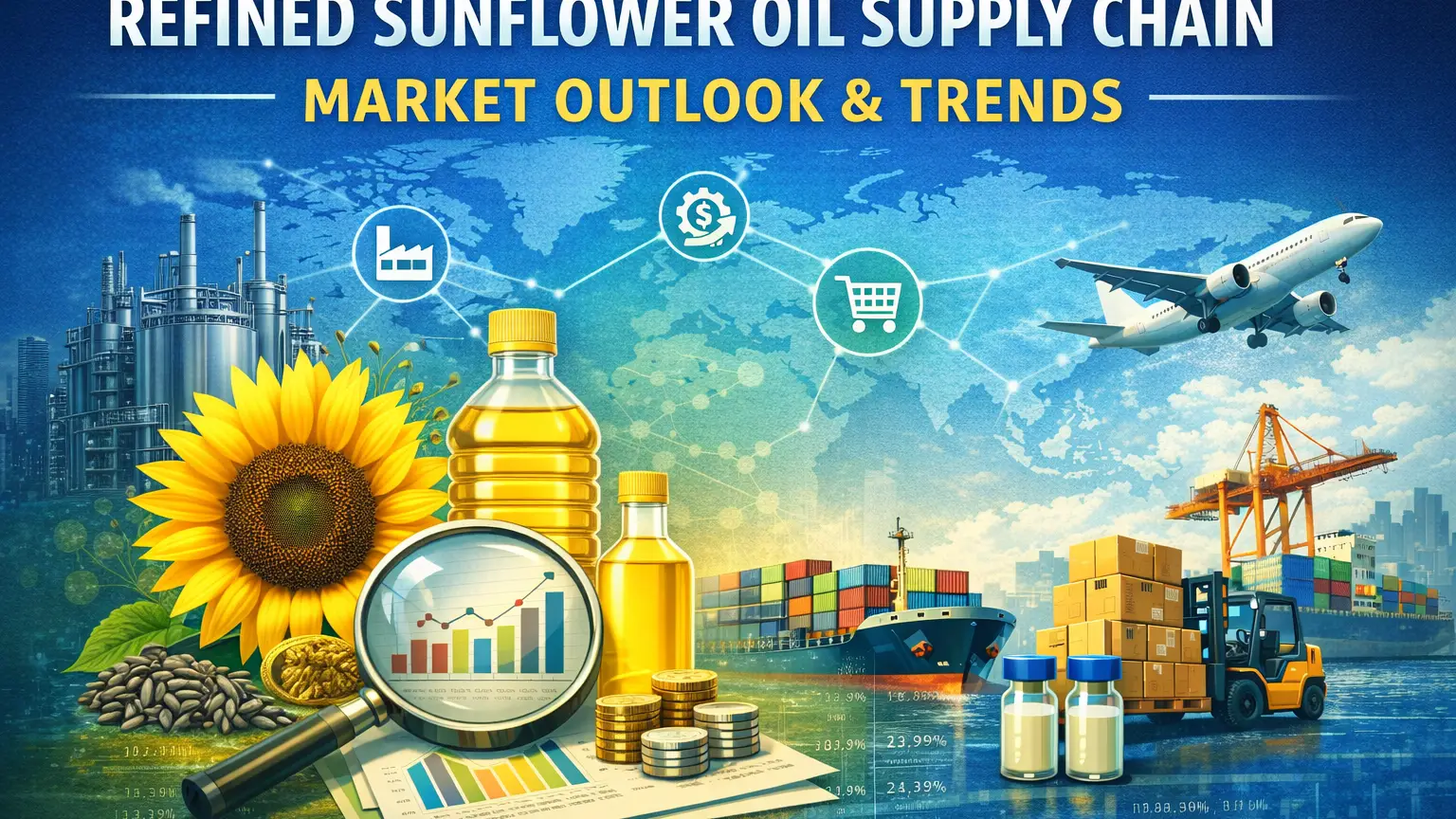
Introduction: Feedstock Dynamics in the Refined Sunflower Oil Market
Black Sea Dominance and Global Supply Concentration
Agricultural Yield Instability and Feedstock Availability
Freight Costs and Logistics in Sunflower Oil Trade
Processing Margins and Feedstock Pricing Pressures
Import Dependency and Feedstock Security
20-Year Outlook: Refined Sunflower Oil as a Platform Chemical (2026–2046)
Conclusion: Future Supply Chain Strategies for the Industry
The refined sunflower oil market in 2026 stands at a critical intersection of global demand growth and persistent supply chain volatility. With the market projected to reach approximately USD 26.24 billion in 2026 and expand steadily at over 6% CAGR, industry players are navigating a complex landscape shaped by geopolitics, sourcing concentration, and evolving trade networks.
A defining characteristic of the refined sunflower oil supply chain is its heavy reliance on sunflower seed production in Eastern Europe, particularly Russia and Ukraine. This geographic concentration exposes the entire value chain to climatic, political, and trade disruptions.
Supply continuity depends on stable agricultural outputs, yet recent years have demonstrated how quickly disruptions can ripple across global markets. As processors and refiners depend on consistent seed input, even minor production shocks translate into significant downstream volatility.
The sunflower oil supply chain is highly internationalized, spanning over 167 countries with thousands of exporters and importers actively engaged in trade.
Emerging markets in Asia and the Middle East continue to rely heavily on imports, driving demand for bulk shipments and refined product distribution. Meanwhile, Europe remains both a production hub and a major consumer, reinforcing its central role in global flows.
This interconnected network has increased efficiency but also heightened exposure to trade policy changes, freight costs, and port congestion.
In 2026, supply chain disruptions remain a dominant concern. Ongoing geopolitical tensions have already triggered sharp price increases and reduced import flows, directly impacting refined sunflower oil availability.
Such disruptions highlight the fragility of logistics infrastructure, including shipping routes, storage capacity, and refining throughput. For B2B buyers, price volatility is no longer cyclical but structural, requiring more agile procurement strategies and diversified sourcing.
To mitigate risks, leading companies are investing in vertical integration and digital supply chain solutions. From farm-level traceability to AI-driven demand forecasting, the industry is shifting toward greater transparency and control.
Major players such as Cargill, Bunge, and ADM are strengthening their upstream and downstream capabilities, ensuring tighter coordination between sourcing, refining, and distribution.
Digital platforms are also enabling real-time tracking of shipments and supplier performance, helping companies respond faster to disruptions and optimize inventory levels.
The refined sunflower oil supply chain in 2026 reflects a market transitioning from efficiency-driven globalization to resilience-focused regionalization. While demand fundamentals remain strong, success increasingly depends on managing sourcing risks, logistics uncertainty, and price volatility.
For companies seeking a reliable partner in this evolving landscape, Tradeasia International offers integrated solutions across sourcing, distribution, and global trade facilitation. With a strong supplier network and market expertise, Tradeasia supports businesses in navigating supply chain complexities while ensuring consistent product availability.
Sources:
We're committed to your privacy. Tradeasia uses the information you provide to us to contact you about our relevant content, products, and services. For more information, check out our privacy policy.


 English
 Indonesian
 简体字
简体字
 العربية
 Español
 Français
 Português
 日本語
日本語
 한국어
한국어
 Tiếng Việt




















