Explore our network of country and industry based websites to access localized information, product offerings, and business services across our group.
Log in to start sending quotation requests for any product.
Don't have an account? Sign Up Here
Home Global Sorbitol Supply Chain Market: Resilience, Risk, and Reconfiguration
Trade Insights | Supply Chain | 26 March 2026
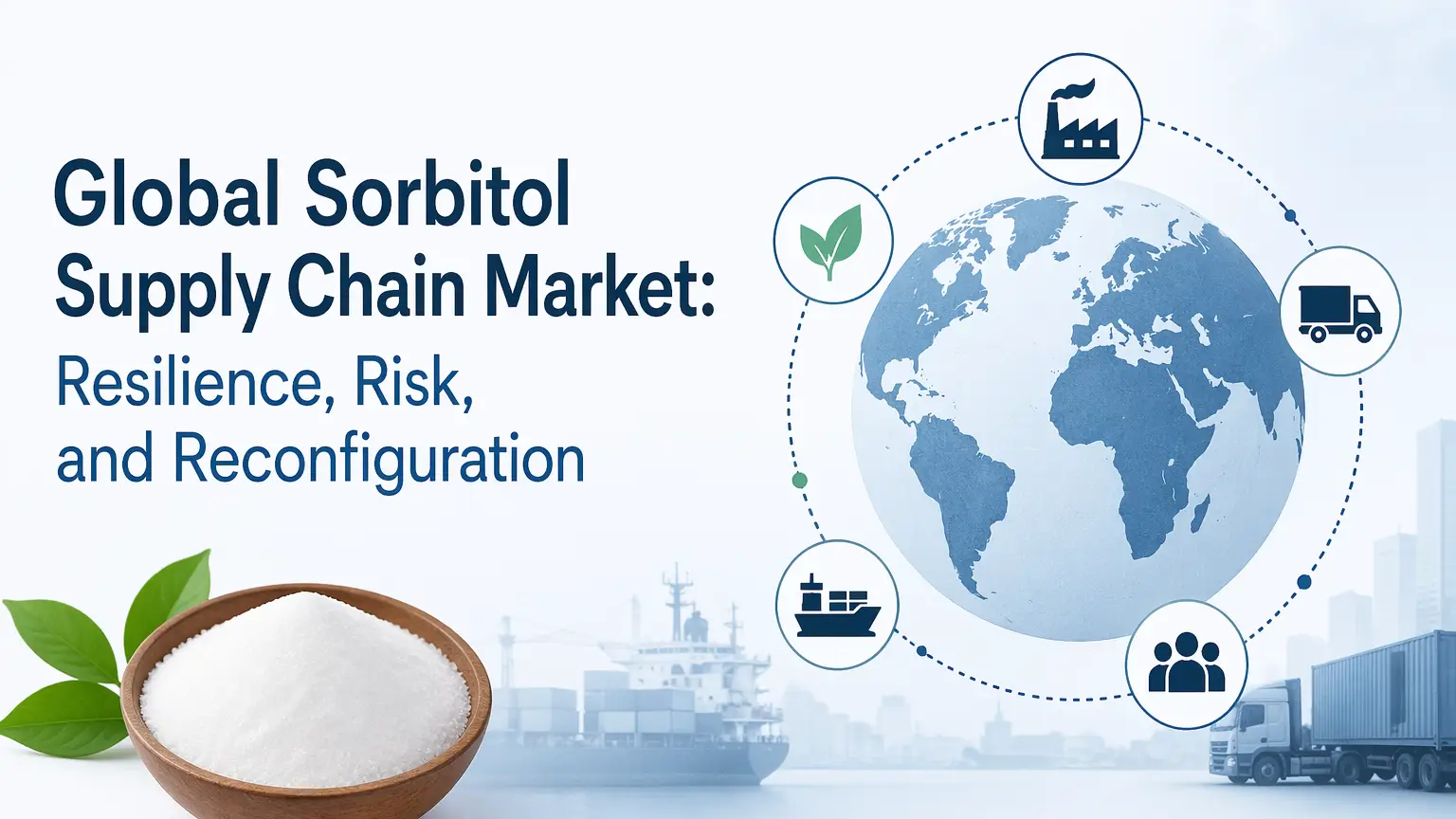
The global sorbitol supply chain in 2026 is no longer defined purely by cost efficiency but by resilience, traceability, and regional adaptability. As a widely used polyol in food, pharmaceuticals, and personal care industries, sorbitol’s supply structure is deeply interconnected with agricultural commodities and chemical processing ecosystems. Market valuation continues to expand steadily, supported by rising demand for low-calorie sweeteners and functional excipients in pharmaceuticals, with Asia-Pacific retaining its dominance in production capacity .
Yet beneath this stable demand trajectory lies a structurally volatile supply chain, increasingly shaped by feedstock dependency and geopolitical trade realignment.
Sorbitol production is heavily reliant on starch-based feedstocks such as corn, wheat, and cassava, making it highly sensitive to agricultural cycles and biofuel competition. In 2026, fluctuating crop yields and fertilizer costs have introduced persistent cost instability across upstream supply nodes. This volatility is not merely cyclical—it is structural, driven by competing demand between food, ethanol, and industrial starch markets.
Producers are increasingly diversifying feedstock sourcing, yet substitution remains limited by technical constraints and processing infrastructure. As a result, sorbitol pricing continues to reflect agricultural inflation almost in real time, compressing margins for downstream processors and distributors. This reinforces a broader industry trend toward integrated sourcing strategies and long-term supplier contracts to mitigate exposure.
Global sorbitol logistics are undergoing significant fragmentation in 2026, particularly as freight volatility and regional trade policies reshape traditional export-import flows. Asia-Pacific remains the dominant production hub, accounting for more than half of global output, but long-haul shipping uncertainties have weakened its cost advantage in some markets.
Europe and North America are increasingly favoring nearshoring strategies, sourcing from regional or semi-regional producers to reduce lead-time risk. This shift is not purely economic; it is driven by supply assurance requirements in regulated sectors such as pharmaceuticals and food processing, where consistency outweighs marginal cost savings.
The result is a more multipolar supply chain structure, where regional production corridors are gaining importance over centralized global supply hubs.
A defining transformation in the sorbitol supply chain is the integration of digital technologies. Predictive analytics, AI-driven demand forecasting, and blockchain-enabled traceability are improving transparency across procurement and distribution networks. These tools allow manufacturers to anticipate demand fluctuations more accurately and optimize production scheduling, reducing waste and storage inefficiencies.
At the same time, sustainability is becoming a non-negotiable supply chain parameter. Buyers are increasingly prioritizing low-emission production routes and certified sustainable sourcing. This shift is gradually creating a two-tier market: conventional sorbitol and premium sustainable-grade sorbitol, the latter commanding higher price positioning due to compliance and ESG alignment pressures.
Together, digitalization and sustainability are reshaping procurement behavior, pushing the industry toward more accountable and data-driven supply ecosystems.
The sorbitol supply chain in 2026 is entering a decisive phase of transformation. What was once a relatively stable, commodity-driven network is now evolving into a complex, risk-managed, and regionally diversified ecosystem. Feedstock volatility, logistics fragmentation, and sustainability requirements are collectively redefining how value is created and preserved across the chain.
As industries increasingly seek resilient sourcing partners capable of navigating these structural shifts, the role of integrated chemical distributors becomes more strategic than ever.
In this context, Tradeasia International stands out as a global solution provider, supporting industries with reliable sourcing networks, diversified supply channels, and consistent product availability across key markets. Its integrated approach helps businesses mitigate supply chain risks while ensuring continuity in a rapidly evolving global sorbitol landscape.
We're committed to your privacy. Tradeasia uses the information you provide to us to contact you about our relevant content, products, and services. For more information, check out our privacy policy.


 English
 Indonesian
 简体字
简体字
 العربية
 Español
 Français
 Português
 日本語
日本語
 한국어
한국어
 Tiếng Việt