Explore our network of country and industry based websites to access localized information, product offerings, and business services across our group.
Log in to start sending quotation requests for any product.
Don't have an account? Sign Up Here
Home Xylitol Supply Chain Market: Trends, Risks, and Growth Dynamics
Trade Insights | Supply Chain | 18 March 2026
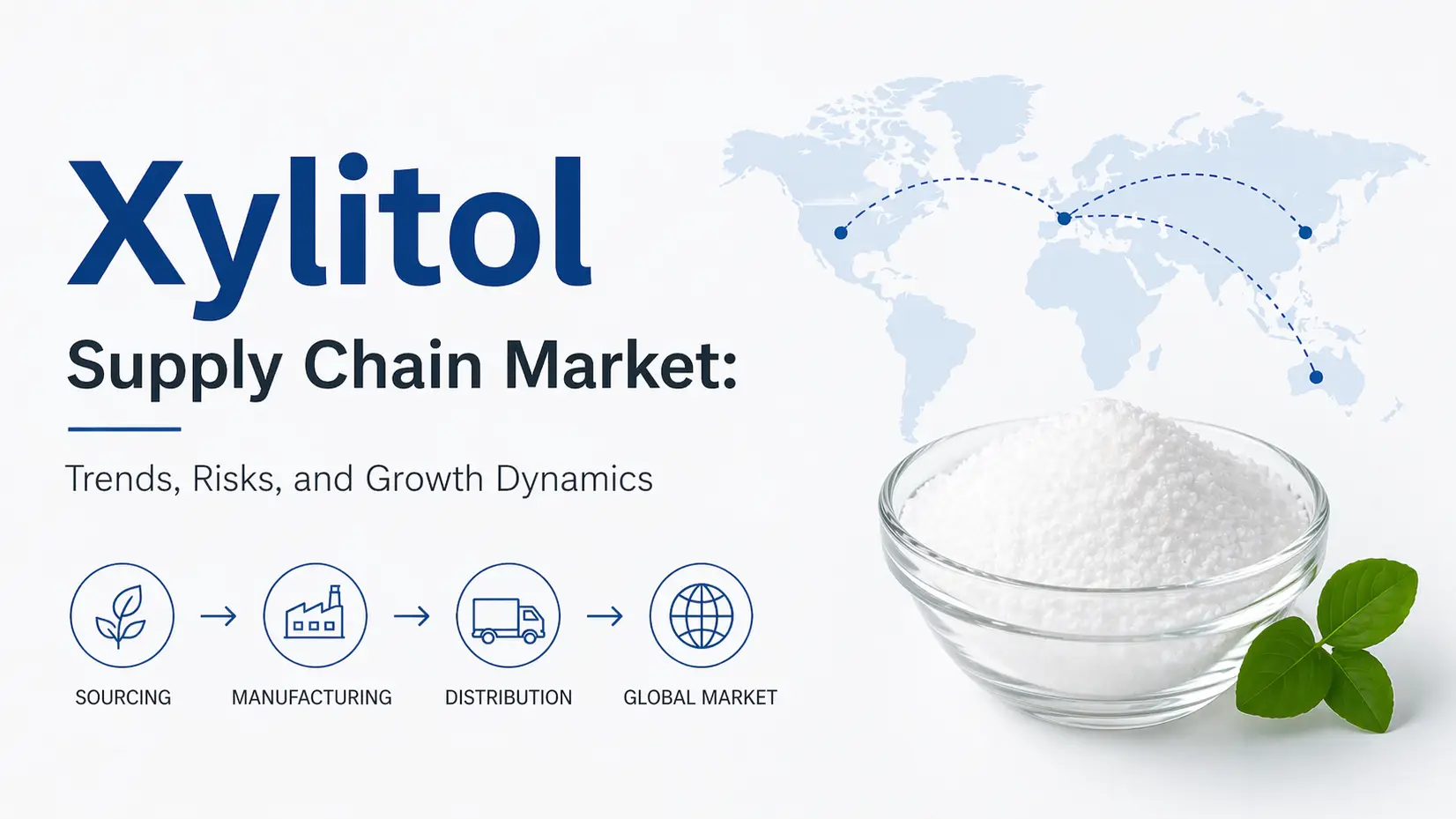
The global xylitol market in 2026 has evolved into a strategically important segment within the broader specialty chemicals and food ingredients industry. Valued at approximately USD 1.29 billion, xylitol demand is fueled by the rapid adoption of low-calorie sweeteners across food, pharmaceutical, and oral care sectors.
However, beyond demand growth, the supply chain has become a defining factor in competitiveness. From raw material sourcing to regional production hubs and logistics networks, the xylitol supply chain is undergoing structural transformation amid geopolitical uncertainty and sustainability pressures.
In 2026, xylitol manufacturers are increasingly regionalizing production to mitigate global trade disruptions. Companies are investing in localized facilities and supplier ecosystems to stabilize costs and reduce dependency on long-distance exports.
Asia-Pacific, particularly China and India, has emerged as a key production hub due to cost advantages and expanding domestic demand. Meanwhile, North America and Europe maintain strong consumption bases but are gradually reshoring parts of their supply chains to enhance resilience. This shift reflects a broader industrial trend toward supply chain decentralization.
The xylitol supply chain is heavily dependent on agricultural feedstocks such as corn cobs and birch wood. Increasing sustainability requirements are pushing producers to diversify raw material sources and adopt circular production models.
Manufacturers are exploring alternative biomass inputs and fermentation technologies to improve yield efficiency and reduce environmental impact. This transition aligns with global demand for clean-label and plant-based ingredients, further strengthening xylitol’s position as a sustainable sweetener option.
As sustainability becomes a procurement priority, supply chains are being redesigned to ensure traceability, reduced carbon footprints, and compliance with evolving regulatory frameworks.
Pricing dynamics in the xylitol market are closely tied to supply chain stability. In 2026, food-grade xylitol averages between USD 2,500–3,000 per metric ton, while pharmaceutical grades command higher premiums due to stringent processing requirements.
Geopolitical tensions, fluctuating energy costs, and port congestion continue to create uneven cost structures across regions. Trade policies, tariffs, and export controls further complicate sourcing strategies, forcing manufacturers to adopt flexible procurement models.
As a result, companies with diversified supply bases and strong logistics networks are better positioned to maintain pricing stability and protect margins in a volatile global environment.
Digitalization and process innovation are reshaping the xylitol supply chain. Advanced fermentation technologies and biomass conversion processes are improving production scalability while lowering costs.
Additionally, companies are leveraging data-driven supply chain management tools to optimize inventory, forecast demand, and reduce lead times. Automation and AI-driven systems are also being deployed to address labor shortages and enhance operational efficiency.
This technological evolution is transforming xylitol from a commodity sweetener into a high-value, application-specific ingredient with a more sophisticated and resilient supply network.
The xylitol supply chain market in 2026 reflects a transition from traditional linear models to more resilient, regionalized, and technology-driven systems. As demand continues to grow across multiple industries, supply chain agility, sustainability, and innovation will remain critical success factors for market participants.
For businesses seeking reliable sourcing and consistent supply, partnering with experienced global distributors becomes increasingly important. Tradeasia International stands out as a trusted solution provider, offering integrated procurement services and strong supplier networks to support manufacturers navigating complex supply chain dynamics.
Sources:
We're committed to your privacy. Tradeasia uses the information you provide to us to contact you about our relevant content, products, and services. For more information, check out our privacy policy.


 English
 Indonesian
 简体字
简体字
 العربية
 Español
 Français
 Português
 日本語
日本語
 한국어
한국어
 Tiếng Việt