
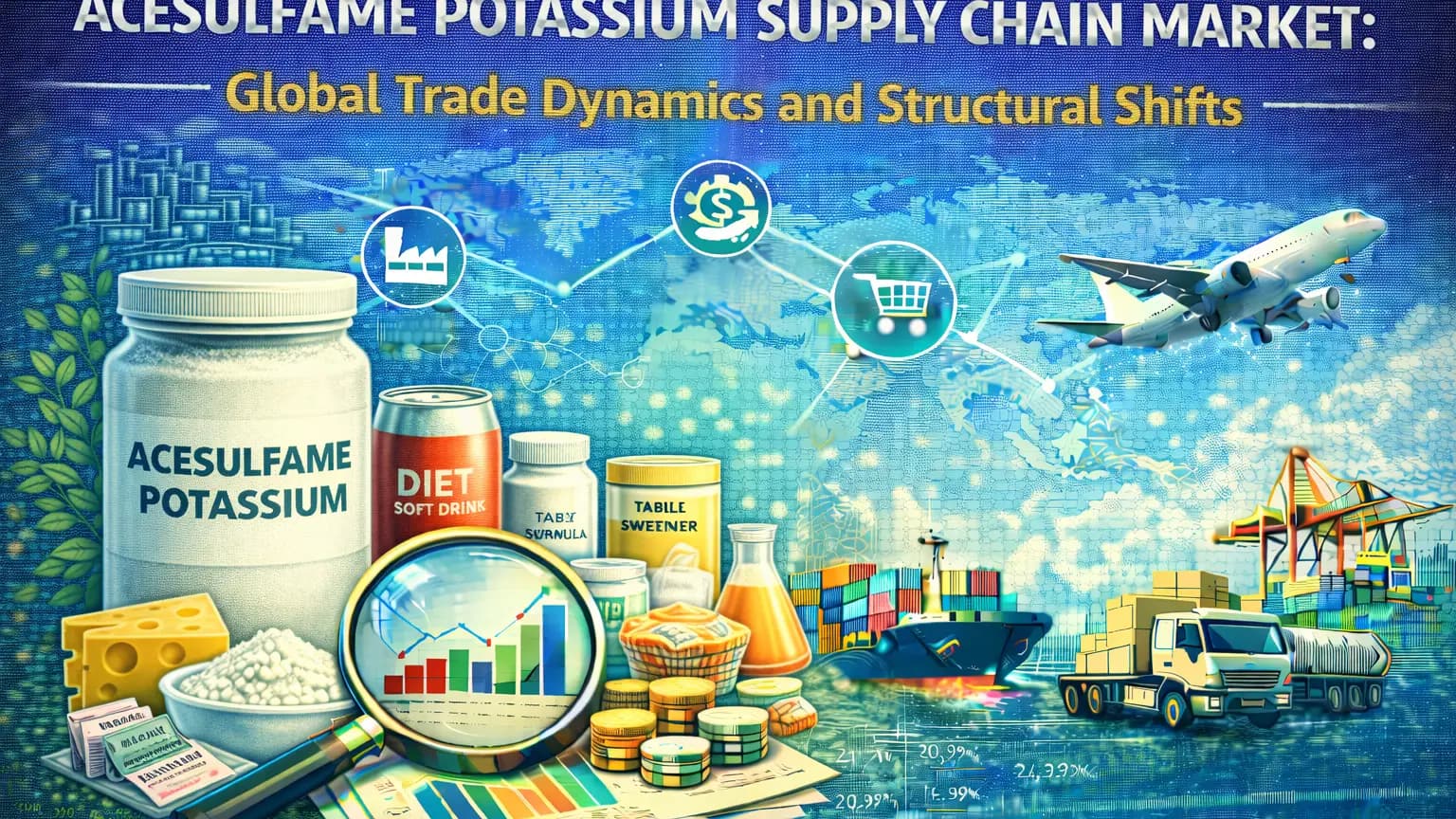
The Evolving Sweetener Supply Chain Landscape
Introduction:
The global supply chain for Acesulfame Potassium (Ace-K) in 2026 reflects a mature yet rapidly adjusting ecosystem shaped by health-driven consumption patterns and industrial reformulation. As a high-intensity sweetener widely used in beverages, pharmaceuticals, and processed foods, Ace-K has transitioned from a niche additive to a critical ingredient in global sugar-reduction strategies.
Market expansion continues to be supported by rising demand for low-calorie formulations, with global valuation projected in the multi-hundred-million-dollar range and steady mid-single-digit CAGR growth through the decade . This sustained demand places increasing pressure on upstream chemical producers, logistics providers, and import-dependent food manufacturers to maintain stable supply continuity.
Asia-Pacific Manufacturing Dominance and Export Flows
In 2026, Asia-Pacific—particularly China—remains the dominant production hub for Ace-K, accounting for the majority of global output due to cost-efficient synthesis and mature chemical infrastructure. Export-oriented manufacturing ecosystems have strengthened significantly, with large-scale production facilities supplying North America, Europe, and Latin America.
This regional concentration has reshaped global trade flows, making supply chains highly dependent on long-distance maritime logistics. China’s pricing advantage continues to position it as the benchmark supplier, while India and Southeast Asian producers increasingly serve as alternative sourcing nodes for diversification strategies .
For global buyers, this concentration introduces both efficiency and risk—cost optimization on one hand, and vulnerability to geopolitical or logistics disruptions on the other.
Regulatory Pressures and Quality Compliance in Global Trade
Acesulfame Potassium operates within one of the most regulated segments of the food additives industry. Compliance standards differ across the U.S. FDA, European EFSA, and Asian food safety authorities, requiring exporters to maintain strict purity grading and documentation consistency.
Recent supply chain evolution has seen a rise in pharmaceutical-grade Ace-K demand, particularly for use in oral medications and nutraceuticals where taste masking is essential. Regulatory alignment is now a key determinant of trade eligibility rather than just product quality, forcing manufacturers to integrate compliance earlier in production planning.
As highlighted in industry analysis, shifting consumer expectations toward clean-label and health-oriented products are also accelerating reformulation cycles across global food manufacturers .
Pricing Volatility, Energy Inputs, and Logistics Realignment
While Ace-K pricing has historically been relatively stable, 2026 introduces renewed volatility due to energy cost fluctuations and geopolitical disruptions affecting chemical production routes. Energy-intensive synthesis processes mean even marginal increases in electricity or feedstock costs directly influence global pricing structures.
Recent supply chain disruptions have also prompted manufacturers to reconsider just-in-time procurement models, shifting toward hybrid inventory strategies that balance cost efficiency with resilience. Meanwhile, shipping bottlenecks and freight reconfiguration are reinforcing the importance of diversified sourcing strategies across multiple Asian production clusters .
These dynamics are gradually reshaping procurement behavior, especially among multinational beverage and food conglomerates seeking supply stability in volatile trade environments.
Conclusion: Strategic Positioning for Tradeasia International
As the Acesulfame Potassium supply chain continues to evolve, market participants increasingly require partners capable of bridging fragmented production bases with stable, compliant global distribution networks. The interplay of regulatory complexity, regional production concentration, and logistics volatility is redefining how procurement decisions are made in 2026.
In this environment, Tradeasia International emerges as a reliable global solution provider, supporting manufacturers with consistent sourcing, cross-border chemical distribution, and supply chain resilience across key industrial markets. Its integrated approach aligns with the industry’s shift toward more transparent and strategically diversified procurement frameworks.
For stakeholders navigating the complexities of Ace-K trade flows, engaging with established distribution partners is no longer optional—it is a structural necessity for long-term operational stability.
Sources
- https://www.globenewswire.com/news-release/2026/01/06/3213909/0/en/Acesulfame-Potassium-Market-Strategy-Report-2026-2030.html
- https://www.chemtradeasia.com/market-insights/acesulfame-potassium-market-trends-forecast-2026-2046
- https://www.newstrail.com/global-united-states-acesulfame-potassium-market-dynamics-2026-2036-supply-chain-insights-market-trajectory/