Explore our network of country and industry based websites to access localized information, product offerings, and business services across our group.
Log in to start sending quotation requests for any product.
Don't have an account? Sign Up Here
Home Industrial Applications and Market Demand for Magnesium Sulphate Heptahydrate
Trade Insights | Applications and Buyers | 08 June 2026
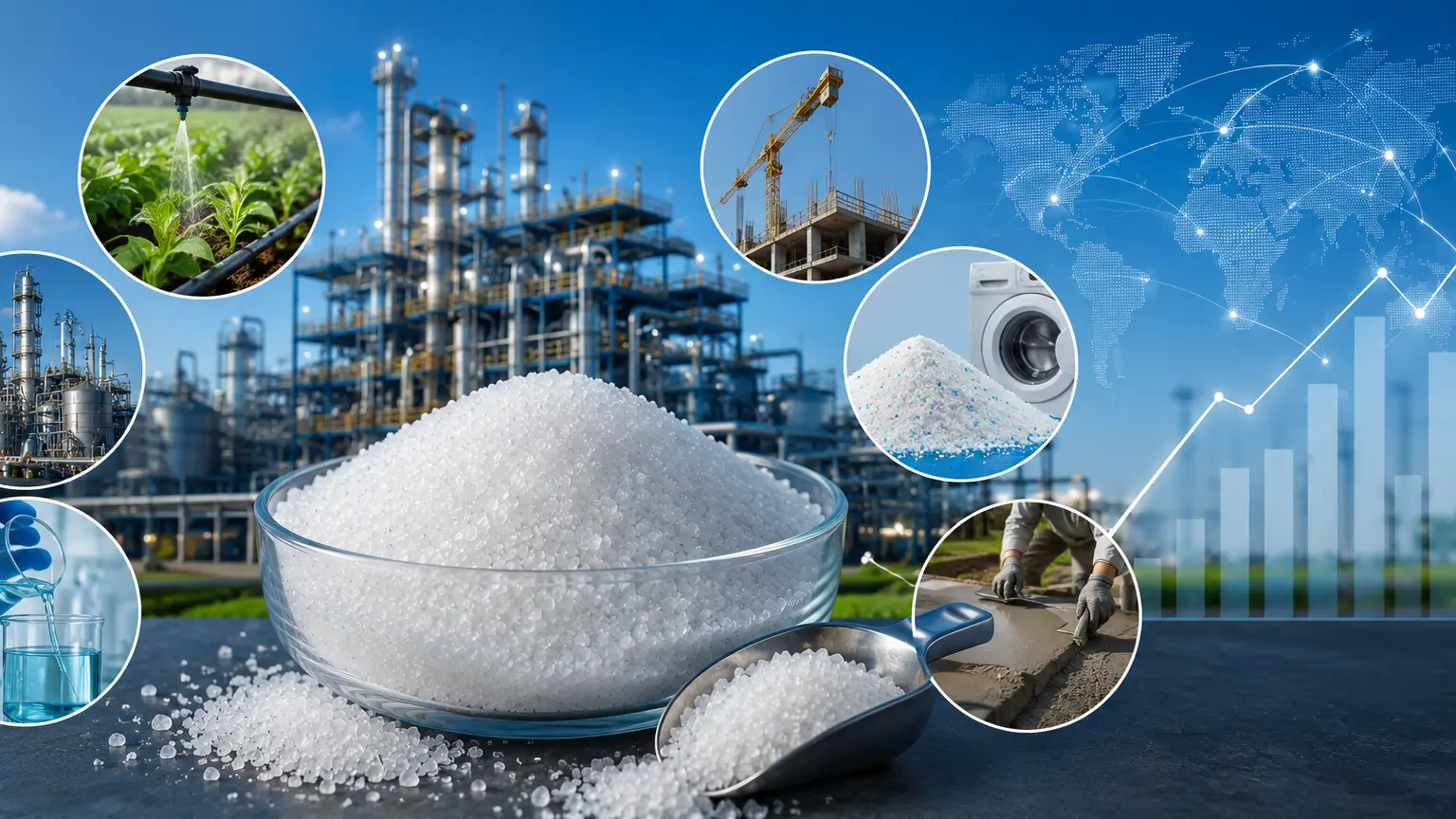
Introduction to Magnesium Sulphate Heptahydrate and Its Chemical Role
Agricultural Applications in Fertilizer and Soil Nutrition
Water Treatment and Industrial Processing Applications
Animal Feed and Pharmaceutical Industry Uses
Global Market Demand and Industry Growth Drivers
Procurement Strategies and B2B Sourcing Considerations
Magnesium sulphate heptahydrate (MgSO₄·7H₂O) is an inorganic salt widely recognized for its high solubility and magnesium content. According to the U.S. Geological Survey (USGS), magnesium compounds play a crucial role in multiple industrial processes due to their reactivity and nutritional value in soil and biological systems.
The compound typically appears as colorless crystals and is commonly known as Epsom salt in its purified form. Its heptahydrate structure allows easy dissociation in water, making it suitable for liquid formulations in agriculture and industrial systems.
From a commercial standpoint, its stability and affordability position it as a key bulk chemical in global trade. Tradeasia and similar B2B platforms facilitate consistent sourcing for industries requiring large-scale magnesium input materials.
The industrial importance of magnesium sulphate heptahydrate lies in its dual role as a nutrient source and process aid. The European Chemicals Agency (ECHA) classifies magnesium salts as widely used substances across agriculture, textiles, and chemical manufacturing.
Its ability to supply both magnesium and sulfur makes it particularly valuable in nutrient-deficient environments. This dual functionality reduces the need for multiple additives in formulations.
As industries move toward efficiency-driven production, demand for multifunctional chemicals like magnesium sulphate heptahydrate continues to grow steadily across global supply chains.
In agriculture, magnesium sulphate heptahydrate is primarily used to address magnesium-deficient soils, a concern highlighted by the Food and Agriculture Organization (FAO). Magnesium is essential for chlorophyll production and photosynthesis efficiency in crops.
The compound is widely applied in crops such as rice, maize, potatoes, and oil palm where soil depletion is common. It is especially effective in intensive farming systems where nutrient imbalance occurs frequently.
Its high solubility allows rapid absorption through foliar sprays or fertigation systems, improving crop response time compared to traditional magnesium sources.
Modern fertilizer blending systems increasingly incorporate magnesium sulphate heptahydrate as a key secondary nutrient component. Reports from the International Fertilizer Development Center (IFDC) indicate growing adoption of magnesium-based fertilizers in precision agriculture.
It is often combined with nitrogen, phosphorus, and potassium (NPK) formulations to enhance crop yield efficiency. This integration supports balanced plant nutrition strategies.
The rise of controlled-environment agriculture and greenhouse farming further increases demand for water-soluble magnesium compounds, reinforcing its agricultural relevance.
Magnesium sulphate heptahydrate is utilized in water treatment processes for mineral balancing and stabilization. According to the U.S. Environmental Protection Agency (EPA), magnesium compounds are used in certain water conditioning systems to adjust hardness and improve process efficiency.
In industrial cooling systems, it helps stabilize water chemistry and reduce scaling risks. Its solubility ensures consistent dosing in large-scale water circulation systems.
This makes it valuable for industries such as power generation, manufacturing, and chemical processing where water quality control is critical.
Beyond water treatment, magnesium sulphate heptahydrate is used as a processing aid in textiles, paper, and detergent manufacturing. It supports dye fixation and improves fiber processing efficiency.
In chemical production, it acts as a drying agent and stabilizer in certain synthesis processes. Its predictable chemical behavior makes it suitable for controlled industrial environments.
As sustainability becomes a priority, industries are increasingly adopting magnesium-based compounds as safer alternatives to harsher chemical additives.
In animal nutrition, magnesium sulphate heptahydrate is used as a feed-grade additive to prevent magnesium deficiency in livestock. The National Research Council highlights magnesium’s role in metabolic and neuromuscular functions in animals.
It is commonly included in cattle and poultry feed formulations to support bone development and energy metabolism. Its water-soluble nature ensures efficient absorption.
Feed manufacturers prefer it due to its cost-effectiveness and compatibility with other mineral premixes used in large-scale livestock production.
In the pharmaceutical industry, magnesium sulphate is widely used in formulations for electrolyte balance and medical treatments. The National Institutes of Health (NIH) notes its relevance in clinical magnesium supplementation therapies.
It is also used in controlled medical applications for muscle relaxation and electrolyte correction. The heptahydrate form ensures stable dosing in pharmaceutical preparations.
Its established safety profile and long history of use make it a trusted compound in regulated healthcare environments.
Global demand for magnesium sulphate heptahydrate is driven primarily by agriculture and industrial processing sectors. Market analysis from World Bank commodity reports indicates increasing consumption of secondary nutrients in emerging economies.
Agricultural modernization and soil nutrient depletion are key contributors to rising demand. Countries with intensive farming practices are the largest consumers.
Industrial expansion in Asia-Pacific and the Middle East further supports growth in chemical procurement volumes.
The global supply chain for magnesium sulphate is influenced by raw material availability and production efficiency. Industry intelligence from ICIS highlights stable but regionally concentrated production hubs.
Trade flows are shaped by fertilizer demand cycles and industrial consumption patterns. This creates consistent opportunities for chemical distributors and B2B marketplaces.
As supply chains become more integrated, reliable sourcing platforms play a critical role in ensuring continuity for end-user industries.
Procurement teams sourcing magnesium sulphate heptahydrate evaluate purity, solubility, pricing stability, and supply reliability. According to WTO trade analysis frameworks, consistency in chemical supply is critical for manufacturing continuity.
Industries also assess packaging formats, bulk availability, and logistics efficiency when selecting suppliers. These factors influence long-term procurement contracts.
Quality assurance and compliance with industrial standards are essential for maintaining downstream application performance.
B2B platforms such as Tradeasia and Chemtradeasia play a significant role in connecting global buyers with verified suppliers. They streamline sourcing processes and reduce procurement risks.
These marketplaces enable buyers to compare specifications, request bulk quotations, and ensure consistent supply chains across regions.
As global demand increases, digital chemical trading platforms are becoming essential infrastructure for efficient industrial procurement and distribution.
Buyers of magnesium sulphate heptahydrate typically include fertilizer manufacturers, agricultural distributors, chemical processors, feed producers, and pharmaceutical companies. Each group uses the compound for its magnesium and sulfur content in different formulations.
Procurement teams focus on purity grade, solubility performance, pricing stability, and supplier reliability before making purchasing decisions. Technical data sheets and compliance documentation are key evaluation tools.
Buyers compare multiple suppliers to ensure consistent supply availability and cost efficiency, especially for bulk industrial applications.
A detailed product page on B2B marketplaces supports sourcing decisions by providing technical specifications, packaging options, and application insights.
Magnesium sulphate heptahydrate holds strong commercial importance due to its multi-industry applicability and stable global demand. Its use across agriculture, water treatment, and feed industries ensures continuous consumption cycles.
Demand is closely tied to agricultural productivity needs and industrial manufacturing growth, making it a strategically important bulk chemical.
Reliable sourcing is essential to avoid production disruptions in downstream industries, particularly in fertilizer blending and industrial processing.
Tradeasia and similar B2B marketplaces provide structured procurement channels that support buyers with consistent supply access and competitive sourcing options.
Sources
We're committed to your privacy. Tradeasia uses the information you provide to us to contact you about our relevant content, products, and services. For more information, check out our privacy policy.


 English
 Indonesian
 简体字
简体字
 العربية
 Español
 Français
 Português
 日本語
日本語
 한국어
한국어
 Tiếng Việt



















