Explore our network of country and industry based websites to access localized information, product offerings, and business services across our group.
Log in to start sending quotation requests for any product.
Don't have an account? Sign Up Here
Home Tapioca Starch in Food & Beverage: Asia Applications & Buyer Demand 2026
Trade Insights | Applications and Buyers | 08 May 2026
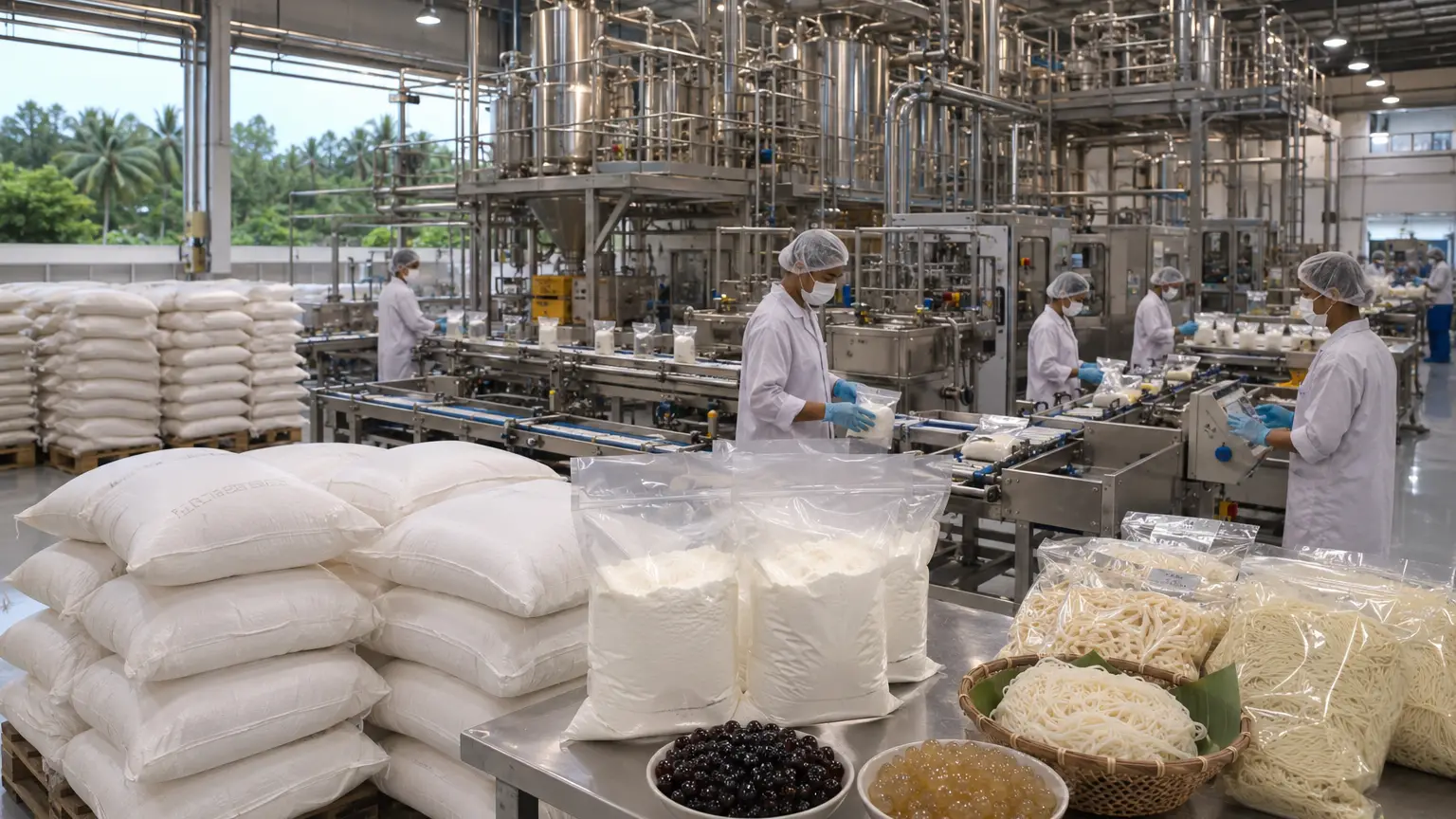
Food and beverage manufacturers across Asia are the single most consequential force shaping tapioca starch procurement in 2026. Accounting for approximately 58% of global tapioca starch consumption, this buyer base is no longer purchasing a basic thickening commodity, it is specifying a functional ingredient with defined viscosity profiles, traceability requirements, and clean-label credentials. Understanding how that demand is distributed across application categories and buyer types is the starting point for any sourcing strategy in this market.
Tapioca starch is a purified carbohydrate extracted from the root of the cassava plant (Manihot esculenta), a tropical crop cultivated extensively across Thailand, Vietnam, Indonesia, and Cambodia. The extraction process involves washing and peeling fresh cassava roots, rasping the pulp to release starch granules, separating and purifying the starch slurry through sedimentation or centrifugation, and drying the recovered starch to produce the fine white powder that enters commercial supply chains.
Three properties make tapioca starch distinctively attractive to food and beverage manufacturers compared to other commercial starches. First, it produces pastes of exceptional clarity, a functional advantage over corn starch and wheat starch in applications such as fruit fillings, clear sauces, and beverage systems where visual quality directly affects consumer perception. Second, it delivers a neutral taste with no grain-forward or earthy notes, allowing it to integrate seamlessly into flavor-sensitive formulations including dairy alternatives, desserts, and beverages. Third, its freeze-thaw stability particularly in modified grades, which maintains gel integrity through temperature cycling that would cause corn starch-based systems to synerise or break down.
These properties, combined with tapioca starch's natural origin and gluten-free status, have made it the ingredient of choice for manufacturers responding to Asia's clean-label reformulation wave. In 2026, food and beverage manufacturers are setting strict specifications for viscosity, moisture retention, and labeling transparency effectively transforming tapioca starch from a cost-management tool into a performance-driven formulation input.
Bubble tea is the highest-profile single application for tapioca starch within the Asian food and beverage sector, and its volume significance is substantial. Tapioca pearls. The chewy, elastic inclusions that define the beverage are produced almost entirely from tapioca starch, exploiting its gel-forming and elasticity properties. Bubble tea alone consumes approximately 12% of global tapioca starch production, with over 4 billion servings consumed annually across Asia-Pacific. The global bubble tea market was valued at USD 2.83 billion in 2025 and is projected to grow to USD 5.62 billion by 2034, advancing at a CAGR of 8.03%. A growth trajectory that directly expands tapioca starch procurement volumes among pearl manufacturers in Taiwan, Thailand, and mainland China.
Beyond pearls, tapioca starch functions as a suspension aid and stabilizer in the beverage format itself. In flavored milks, fruit-based drinks, plant-based beverages, and ready-to-drink (RTD) teas, it prevents sediment formation and maintains homogeneity over the product's shelf life. Non-dairy beverages including oat milk, almond milk, and soy milk use tapioca starch to maintain consistent texture and ensure that solids remain uniformly dispersed rather than settling at the bottom of the bottle, a critical quality parameter for retail products in competitive markets such as China, Japan, and South Korea.
The bakery and confectionery segment is the largest volume application category for food-grade tapioca starch across Asia by weight. In gluten-free bakery products, a category that registered a 21% increase in tapioca starch consumption in 2024. Tapioca starch provides essential structure, moisture retention, and the chewiness that gluten-free formulations struggle to deliver through other means. In cakes, breads, and pastries, it improves crust development and contributes a texture profile that wheat-based products achieve through gluten network formation.
In confectionery, tapioca starch delivers the characteristic chewiness in gummies, fruit snacks, and mochi products categories with strong domestic demand across East and Southeast Asia. It also serves as a binding and crisping agent in coatings and glazes for snacks and crackers, where its film-forming properties improve both texture and visual appeal. The confectionery application is particularly significant in China, where tapioca starch is extensively used in traditional jelly-based sweets and innovative chewy snack formats that have gained domestic and export traction.
Tapioca starch occupies a structurally important role in Asian noodle and processed food manufacturing that predates modern clean-label trends by decades. Transparent noodles, glass noodles, vermicelli, and bean thread variants consumed widely across China, Vietnam, Thailand, and the Philippines rely on tapioca or cassava starch for their characteristic translucency and elastic texture. In China specifically, the majority of domestically consumed tapioca starch is processed into vermicelli and similar noodle formats before moving to modified starch production for industrial applications.
In instant noodles and soups, tapioca starch contributes to viscosity development and texture during rehydration, properties that determine consumer satisfaction in a product format where rehydration speed and mouthfeel consistency are measurable quality parameters. In meat and seafood processing, it functions as a water-retention agent that improves product yield, reduces cooking loss, and delivers a firm, elastic bite in processed meat sticks, fish balls, and surimi products. These applications are commercially significant in the ASEAN food processing industry, particularly in Thailand and Indonesia where seafood processing is a major export sector.
Plant-based dairy alternatives represent the fastest-growing application category for tapioca starch among food manufacturers across Asia in 2026. As manufacturers of plant-based yogurts, dairy-free cheeses, and vegan creamers scale production to meet rapidly expanding consumer demand across China, Japan, South Korea, and urban markets in Southeast Asia, tapioca starch has become a primary texturizer for achieving the creaminess and mouthfeel that consumers expect from dairy products.
The rise of plant-based dairy alternatives has also triggered demand for tapioca starch with specific gel strength and viscosity profiles requirements that command price premiums above USD 500 per metric tonne on tight supply. This application-driven specification pressure is reshaping how processors formulate and how buyers source: manufacturers are moving from spot purchasing to structured supply agreements that include performance specifications tied to gel behavior, particle size distribution, and moisture content limits.
Sauces and condiments are a high-volume, stable demand category for tapioca starch across the entire Asian food processing industry. From oyster sauce and chili sauce to salad dressings and fruit-based fillings, tapioca starch provides the thickening, glossy appearance, and stability that are standard quality markers across these product types. Its clarity advantage over corn starch is particularly valued in fruit-based sauces and fillings where a transparent, glossy finish is an indicator of product quality for both retail buyers and food service operators.
In ready-to-eat and convenience meal formats, a segment expanding rapidly as urbanization drives demand for packaged food solutions across China, India, and Southeast Asia tapioca starch stabilizes sauces and gravies that must maintain consistent texture through shelf storage and microwave or steam reheating. The convenience food segment, driven by middle-class expansion and changing consumption patterns across Asia, is one of the most reliable structural demand drivers for food-grade tapioca starch entering 2026.
The largest volume buyers of food-grade tapioca starch in Asia are multinational and large regional food manufacturers with vertically integrated or contract manufacturing operations across the region. These buyers, which include companies producing instant noodles, snack foods, beverages, dairy alternatives, and processed meats typically procure tapioca starch under long-term supply contracts with annual volume commitments and quarterly price adjustment mechanisms linked to cassava feedstock benchmark pricing.
Their procurement requirements are increasingly specification-intensive. Documentation requirements now commonly include ISO 22000 or HACCP certification, a Certificate of Analysis (COA) for each lot, moisture and ash content specifications within defined ranges, and for export-oriented manufacturers supplying Western retail chains non-GMO verified status and traceability documentation back to the cassava cultivation origin. The largest buyers in this segment are setting these requirements as baseline qualification criteria for supplier approval, a shift from the earlier commodity-trading model where price drove nearly all procurement decisions.
Pearl manufacturers and bubble tea ingredient producers represent a specialized but commercially significant buyer segment concentrated in Taiwan, Thailand, and China. These manufacturers purchase food-grade tapioca starch in high volumes and process it into the chewy pearls, popping boba, and konjac-based inclusions that supply the global bubble tea industry. Their procurement is characterized by sensitivity to starch functional performance, particularly the gel strength, elasticity, and water absorption profile of tapioca starch and by the need to source consistently to maintain product texture across large batch volumes.
This segment's growth is directly coupled to bubble tea outlet expansion across Asia-Pacific, where the format continues to open new markets in secondary and tertiary cities across China, Vietnam, Indonesia, and India. Pearl manufacturers experiencing rapid production scale-up are among the buyers most actively transitioning from spot purchasing to longer-term supply relationships, specifically to secure consistent starch specifications at predictable pricing.
Small and medium food processors like regional sauce manufacturers, local noodle producers, bakery suppliers, and snack food makers form the most numerous buyer segment for food-grade tapioca starch across Asia. Their procurement is typically handled through trading companies and ingredient distributors rather than directly from producers, and their order volumes range from bags to small container loads. This segment is the most price-sensitive and is more likely to shift between tapioca starch and competing starches such as corn or modified potato starch based on relative pricing.
For distributors and regional ingredient suppliers, SME food processors represent the bread-and-butter of tapioca starch volume in markets such as India, the Philippines, and Vietnam, where the food processing sector is structurally fragmented. Serving this buyer segment requires localized warehousing, flexible order sizes, fast documentation turnaround, and the ability to provide basic technical support on formulation application, a capability that distinguishes full-service ingredient suppliers from commodity traders.
Thailand, Vietnam, and Indonesia account for over 70% of global tapioca starch exports, making Asia-Pacific not only the dominant production zone but also the primary procurement origin for Asian food manufacturers. Thailand is widely regarded as the premium-consistency origin, with established processing infrastructure and a strong focus on export quality standards. Vietnam has emerged as a cost-competitive alternative with growing processing capacity, particularly around Ho Chi Minh City and Nghe An province. Indonesia offers additional supply depth for industrial and food-grade requirements.
The most important procurement evolution in the Asian tapioca starch market in 2026 is the shift from spot purchasing to contract-based sourcing driven by cassava feedstock volatility and supply chain disruptions experienced in 2022-2024. Large-scale food manufacturers are increasingly co-planning procurement with suppliers using forward pricing agreements and volume commitments that stabilize supply continuity against seasonal cassava yield fluctuations. For buyers consuming more than 100 metric tonnes annually, term supply relationships with verified suppliers offer meaningfully lower execution risk than reactive spot procurement.
Tradeasia International supplies food-grade tapioca starch sourced from Thailand and Vietnam to food and beverage manufacturers across Asia, with country-specific operations in Indonesia, Singapore, the Philippines, India, and Vietnam. Buyers seeking consistent grade specifications, full documentation support, and flexible procurement from bags to full container loads can contact our regional teams or explore the full tapioca starch product range at foodingredientsasia.com to request specifications and pricing.
The global cassava and tapioca starch market is projected to grow from USD 4.54 billion in 2026 to USD 7.75 billion by 2035, at a CAGR of 6.2%. Within that trajectory, food and beverage applications will remain the anchor demand segment, but the composition of that demand is shifting in ways that matter for procurement strategy. The fastest growth is not coming from traditional volume applications such as noodles and basic sauces, which are growing at rates consistent with broader food market expansion. It is coming from plant-based dairy alternatives, clean-label reformulations, and functional beverage formats — all categories where performance specifications are tightening and supplier qualification requirements are increasing.
For buyers across Asia, this means that the competitive advantage in tapioca starch procurement through 2030 will not be captured by price-only optimization. Manufacturers that establish structured supply relationships with documented, specification-consistent sourcing origins and that invest in supplier technical collaboration to develop application-specific starch grades will be better positioned to manage both supply risk and formulation performance as the market grows more demanding on both dimensions simultaneously.
What is tapioca starch? Tapioca starch is a purified carbohydrate extracted from cassava roots. It is a fine white powder valued in food applications for its exceptional paste clarity, neutral taste, and freeze-thaw stability. It is naturally gluten-free and hypoallergenic, making it compatible with clean-label and allergen-free food formulations.
What is tapioca starch used for in food and beverage manufacturing? Tapioca starch is used as a thickener in sauces, soups, and gravies; a stabilizer in beverages including bubble tea and dairy alternatives; a binding and texturizing agent in bakery, confectionery, and noodle products; and a water-retention agent in processed meat and seafood applications.
Why do Asian food manufacturers prefer tapioca starch over corn starch? Tapioca starch produces clearer, more transparent pastes than corn starch, making it preferred for fruit fillings, sauces, and beverage applications where visual clarity is important. It also has a neutral flavor profile that does not interfere with delicate taste formulations, and it is naturally gluten-free.
What grades of tapioca starch are available for food buyers in Asia? The main commercial grades are native (unmodified) food-grade tapioca starch, and modified variants including hydroxypropylated, cross-linked, and acetylated starches, each designed to deliver enhanced performance under specific processing conditions such as high temperature, acidic pH, or freeze-thaw cycling.
What certifications should Asian food buyers require from tapioca starch suppliers? At minimum, buyers should require a Certificate of Analysis (COA), ISO 22000 or HACCP certification, and a Safety Data Sheet. For export-oriented manufacturers, non-GMO verified status and origin traceability documentation are increasingly required. Halal certification is essential for products entering markets with Muslim consumer bases.
Where is most tapioca starch for Asia produced? Thailand, Vietnam, and Indonesia account for over 70% of global tapioca starch exports. Thailand is the premium-quality origin preferred for specification-sensitive food applications. Vietnam offers cost-competitive alternatives with growing capacity, and Indonesia provides additional supply depth for both food and industrial grades.
Where can I find a reliable tapioca starch supplier in Asia? Tradeasia International supplies food-grade tapioca starch from Thailand and Vietnam to food and beverage manufacturers across Asia. Visit chemtradeasia.com or foodingredientsasia.com to request product specifications, certification documentation, and competitive pricing.
We're committed to your privacy. Tradeasia uses the information you provide to us to contact you about our relevant content, products, and services. For more information, check out our privacy policy.


 English
 Indonesian
 简体字
简体字
 العربية
 Español
 Français
 Português
 日本語
日本語
 한국어
한국어
 Tiếng Việt