Explore our network of country and industry based websites to access localized information, product offerings, and business services across our group.
Log in to start sending quotation requests for any product.
Don't have an account? Sign Up Here
Home Optimizing Corn Steep Liquor Supply Chains for Sustainable Bio-based Production
Trade Insights | Supply Chain | 08 May 2026
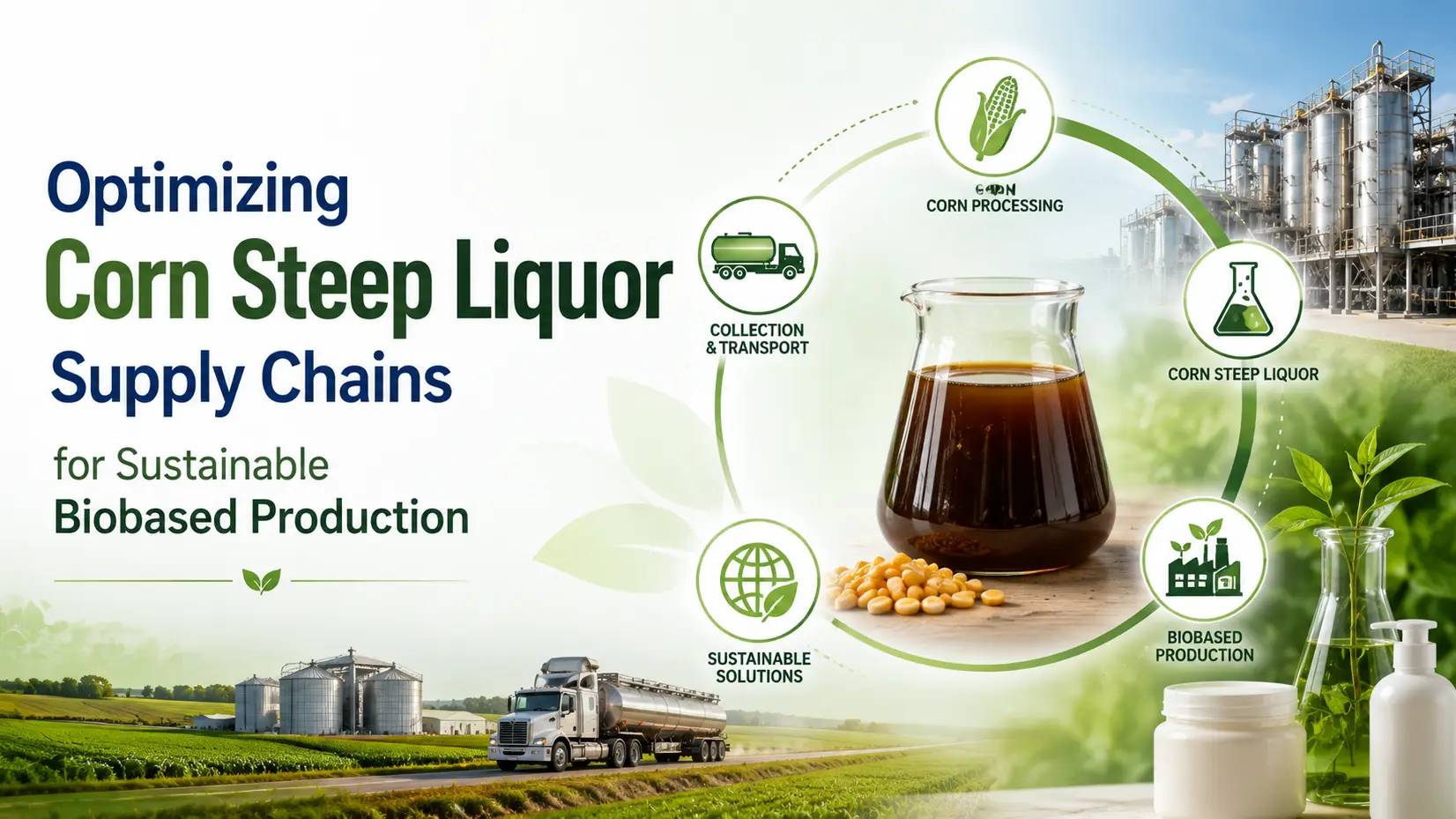
Corn steep liquor (CSL), a nutrient-rich byproduct of the corn wet milling process, has become an indispensable input for fermentation-based industries ranging from amino acids to biofuels. As global demand for biobased production accelerates, CSL supply chains are under increasing pressure to deliver consistency, traceability, and sustainability. Optimizing these networks is no longer optional—it is a strategic necessity for manufacturers seeking cost efficiency and environmental alignment in a competitive industrial landscape.
The CSL supply chain begins with corn procurement, heavily concentrated in agricultural hubs such as the United States Midwest. Integration with wet milling facilities ensures that corn is processed efficiently into starch, oil, and protein streams, with CSL emerging as a key liquid byproduct. Any disruption in corn sourcing—whether due to climate variability or trade restrictions—directly affects downstream CSL availability, making agricultural stability a critical supply chain pillar.
CSL is generated during steeping, where corn kernels are soaked to soften and separate components. Efficiency in this stage determines nutrient concentration and overall yield quality. Modern wet mills increasingly adopt controlled fermentation and enzyme-assisted processes to maximize extractable nutrients. Optimizing this phase reduces waste while improving CSL consistency for industrial users who rely on precise fermentation inputs.
Unlike dry commodities, CSL is a perishable liquid requiring temperature-controlled storage and timely transportation. Supply chain operators must manage microbial stability while minimizing degradation during transit. Bulk tanker logistics and proximity between wet mills and end-users significantly influence cost structures. Inefficiencies in storage or delays in transport can quickly reduce CSL’s functional value in fermentation processes.
Industrial applications demand highly standardized CSL composition, particularly in amino acid and enzyme production. Variations in protein, lactic acid, or mineral content can disrupt fermentation yields. As a result, suppliers are investing in advanced analytical testing and real-time monitoring systems. Standardization protocols are becoming essential to maintain trust across global biomanufacturing networks.
CSL exemplifies circular economy principles by converting agricultural byproducts into high-value industrial inputs. Its utilization reduces waste from corn processing while lowering reliance on synthetic nutrient sources. Companies integrating CSL into sustainable supply chains benefit from reduced environmental footprints and alignment with global decarbonization goals in industrial biotechnology.
The rising demand for bio-based chemicals, enzymes, and pharmaceuticals is accelerating CSL consumption. Fermentation-driven industries depend on CSL as a cost-effective nutrient source that supports microbial growth at scale. This demand surge is reshaping global supply chain priorities, pushing producers to expand capacity and improve distribution efficiency.
As industries transition toward bio-based manufacturing, optimizing corn steep liquor supply chains has become a strategic lever for both cost and sustainability performance. Companies that align sourcing, processing, and logistics gain a competitive advantage in the expanding fermentation economy.
In this evolving landscape, global traders and distributors play a vital role in ensuring reliable access and quality consistency. Tradeasia International continues to support industrial buyers with integrated chemical supply solutions, helping bridge raw material sourcing with dependable global distribution networks.
We're committed to your privacy. Tradeasia uses the information you provide to us to contact you about our relevant content, products, and services. For more information, check out our privacy policy.


 English
 Indonesian
 简体字
简体字
 العربية
 Español
 Français
 Português
 日本語
日本語
 한국어
한국어
 Tiếng Việt