Explore our network of country and industry based websites to access localized information, product offerings, and business services across our group.
Log in to start sending quotation requests for any product.
Don't have an account? Sign Up Here
Home Potassium Sorbate Supply Chain Risks: Shortages, Pricing, and Disruptions
Trade Insights | Supply Chain | 15 May 2026
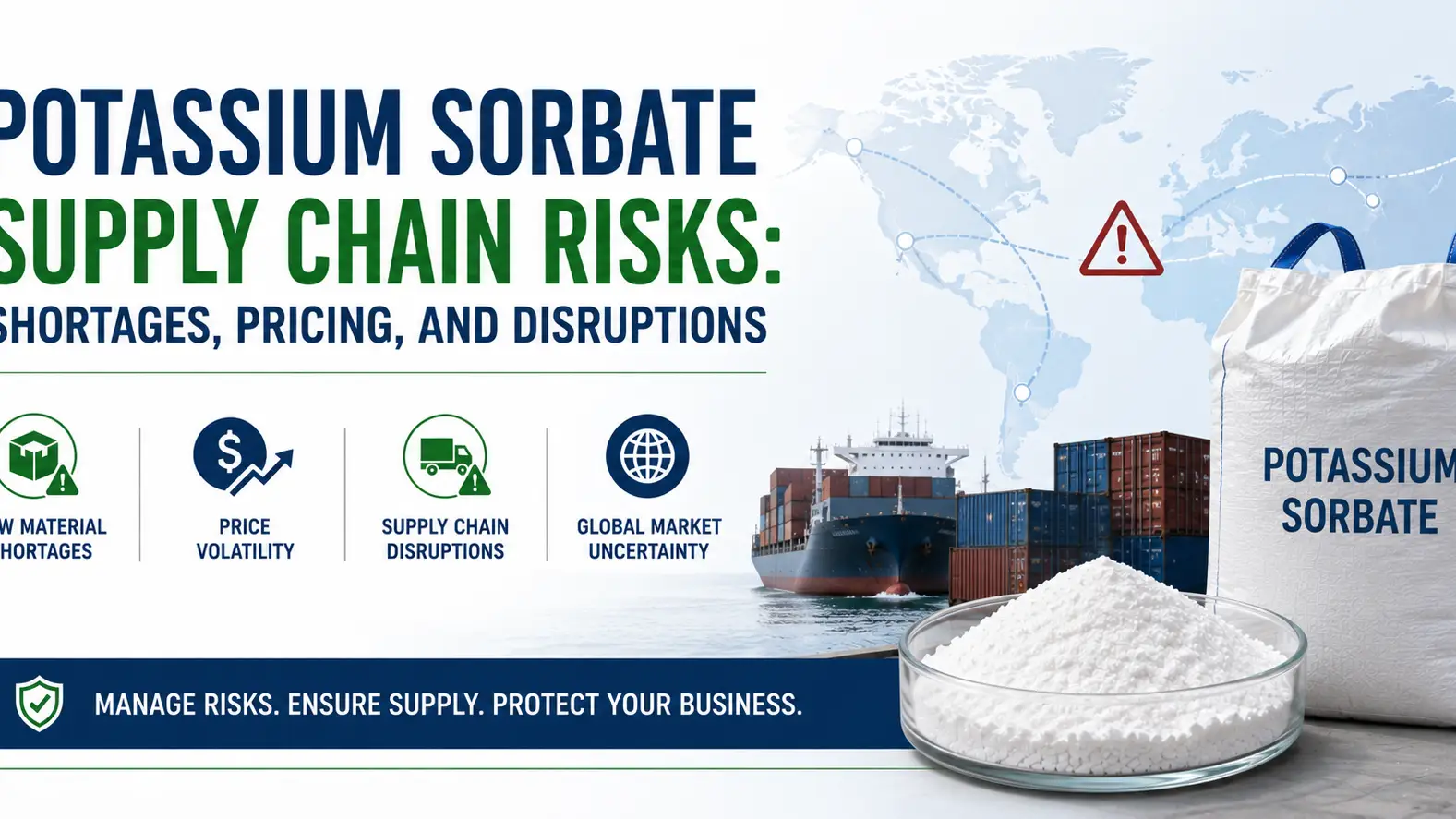
Potassium sorbate, a widely used food-grade preservative, plays a critical role in extending shelf life across food, beverage, and personal care industries. However, its global supply chain is increasingly exposed to volatility driven by raw material dependency, concentrated manufacturing bases, and shifting trade logistics. In recent years, buyers and manufacturers have faced recurring disruptions that have affected both availability and pricing stability across major markets such as North America, Europe, and Asia.
The potassium sorbate supply chain begins with sorbic acid and related chemical inputs, making upstream availability a critical risk factor. Any fluctuation in feedstock production immediately affects output capacity and pricing stability. With manufacturing heavily concentrated in a few major producing countries, particularly in Asia, even minor operational disruptions can ripple across global markets. According to industry analysis, volatility in raw material costs and production inputs remains one of the most persistent challenges for manufacturers worldwide.
Global potassium sorbate trade is highly dependent on a limited number of exporting regions. This concentration increases vulnerability when regulatory inspections, environmental compliance checks, or production cuts occur. Recent market patterns show that reductions in output from key Asian producers have led to tightening supply conditions in import-dependent regions like North America and Europe. Such geographic imbalance amplifies risk exposure for buyers relying on long supply chains.
Shipping costs and logistics capacity play a major role in determining landed prices. When freight rates rise or container availability tightens, potassium sorbate becomes significantly more expensive for downstream buyers. Port congestion, delayed shipments, and global transportation disruptions have historically contributed to unpredictable delivery timelines. Even when production remains stable, logistics inefficiencies can create artificial shortages in regional markets.
The demand for potassium sorbate is closely tied to food, beverage, pharmaceutical, and personal care industries. Seasonal consumption cycles and economic conditions directly influence procurement behavior. During periods of weak consumer demand or macroeconomic uncertainty, buyers reduce purchasing volumes, which can lead to oversupply. Conversely, sudden restocking cycles often create sharp spikes in demand, tightening supply chains unexpectedly.
Inventory management strategies significantly shape market stability. In times of uncertainty, buyers often adopt defensive purchasing, building excess stock to hedge against potential disruptions. However, this behavior can later contribute to oversupply conditions, followed by price corrections. Market data indicates that inventory imbalance remains a key driver of short-term volatility in potassium sorbate pricing across global markets.
Potassium sorbate pricing is highly sensitive to supply-demand imbalances and external cost pressures. Factors such as freight costs, currency fluctuations, and feedstock pricing contribute to continuous price adjustments. In tightly supplied markets, even minor disruptions can trigger speculative buying behavior, further amplifying price volatility. As a result, buyers increasingly monitor upstream and logistical indicators to anticipate price shifts.
The potassium sorbate supply chain is evolving under the influence of structural vulnerabilities, from concentrated production hubs to global logistics uncertainty. These factors collectively contribute to recurring shortages, pricing fluctuations, and procurement challenges across industries that depend on this essential preservative.
As global markets continue to face volatility, businesses are increasingly seeking resilient sourcing strategies and diversified supply networks. In this context, partnering with experienced global distributors becomes essential for ensuring continuity and cost efficiency.
Tradeasia International stands as a trusted global solution provider in the chemical distribution sector, offering reliable sourcing, streamlined logistics, and strong supply chain connectivity across multiple regions. Its integrated network helps industries mitigate risk while ensuring consistent access to critical raw materials like potassium sorbate in an increasingly complex global market.
Sources :
We're committed to your privacy. Tradeasia uses the information you provide to us to contact you about our relevant content, products, and services. For more information, check out our privacy policy.


 English
 Indonesian
 简体字
简体字
 العربية
 Español
 Français
 Português
 日本語
日本語
 한국어
한국어
 Tiếng Việt