Explore our network of country and industry based websites to access localized information, product offerings, and business services across our group.
Log in to start sending quotation requests for any product.
Don't have an account? Sign Up Here
Home Ocean to Industry: End-to-End Process of Sodium Alginate
Trade Insights | Supply Chain | 05 May 2026
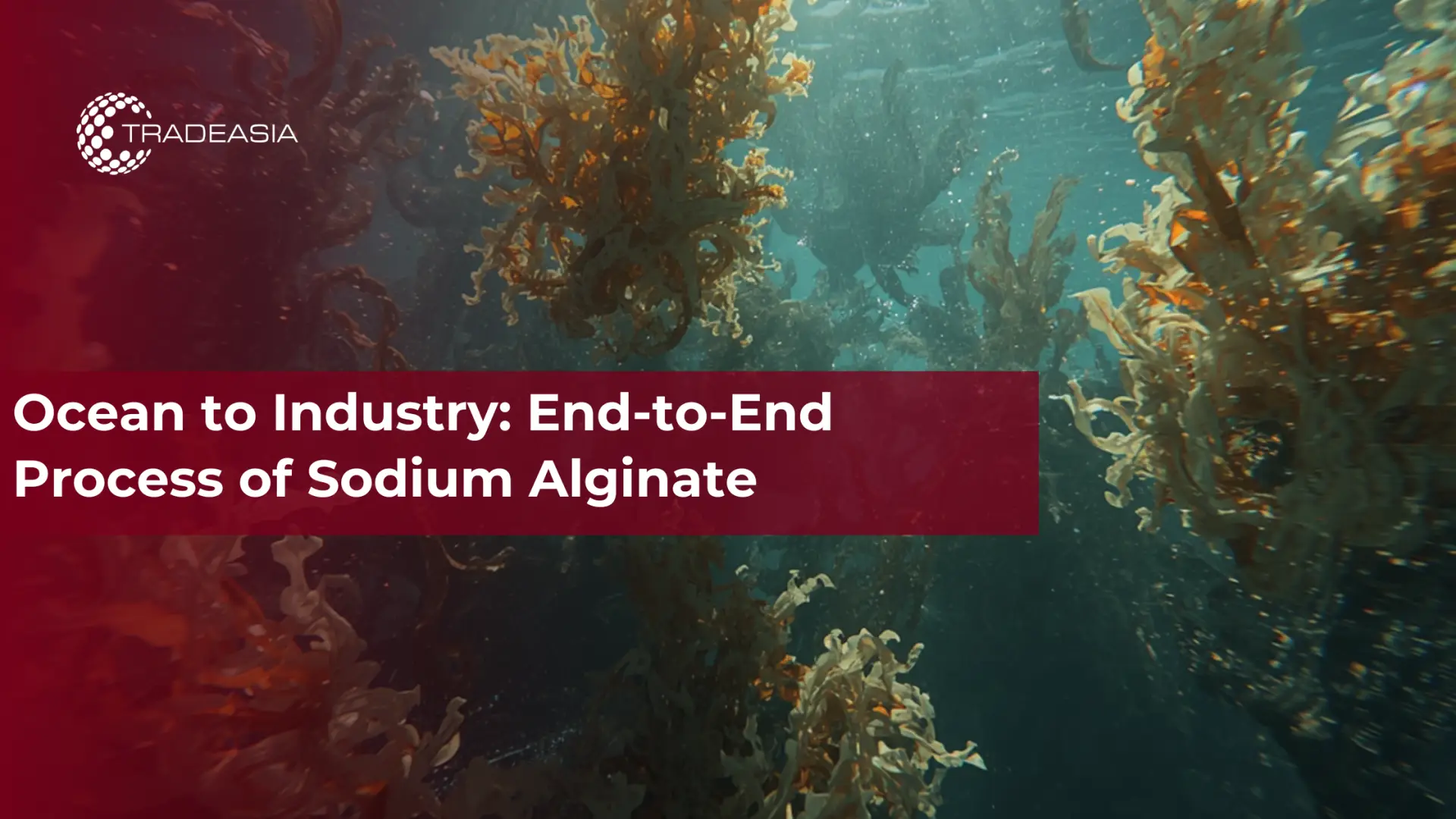
Sodium alginate stands as one of the most strategically important hydrocolloids in the global ingredient landscape, not only because of its multifunctional performance but also because of the unique and complex journey it undertakes from marine ecosystems to industrial applications. Extracted from brown seaweed, sodium alginate represents a rare case where ocean-derived biomass is converted into a highly engineered, specification-driven ingredient used across food, pharmaceutical, and industrial sectors. This transformation is far from linear; it involves a deeply technical, multi-stage processing chain that integrates biological variability, chemical engineering, and strict quality control systems.
The increasing demand for sodium alginate is closely tied to macro trends in the global economy. In the food industry, the shift toward plant-based, clean-label, and texturally enhanced products has driven higher usage of hydrocolloids. In pharmaceuticals, the need for controlled-release drug systems and biocompatible materials has expanded alginate’s role in advanced formulations. Meanwhile, industrial applications such as textile printing, paper coating, and oil drilling continue to consume large volumes, creating a multi-sector demand structure that adds complexity to supply chain management.
Understanding the processing chain of sodium alginate is therefore not only a technical exercise but also a strategic necessity. Each stage—from seaweed sourcing and extraction to refinement and grade differentiation—directly influences supply reliability, cost structures, and application performance. This article provides an extensive and deeply detailed exploration of these stages, offering insights into the technologies, challenges, and market implications that define the global sodium alginate industry.
At the foundation of sodium alginate production lies brown seaweed, a marine resource that introduces a level of biological complexity rarely seen in land-based raw materials. Species such as Laminaria, Macrocystis, and Ascophyllum nodosum are the primary sources of alginic acid, but each species differs in terms of polymer composition, molecular weight distribution, and extraction yield. These differences are not merely academic; they have direct implications for processing efficiency and the functional properties of the final product.
The alginate content within seaweed is influenced by a wide range of environmental factors, including water temperature, seasonal cycles, nutrient availability, and ocean currents. For example, colder waters tend to produce seaweed with higher viscosity alginates, which are preferred for certain industrial and pharmaceutical applications. Conversely, warmer conditions may yield lower-viscosity material, which can still be valuable for food applications but may require additional processing adjustments.
Geographically, the global supply of brown seaweed is concentrated in a few key regions. China dominates both cultivation and processing, benefiting from extensive coastal infrastructure and a long history of seaweed farming. Indonesia and the Philippines are emerging as important suppliers, particularly for tropical species, while Chile and parts of Europe contribute to supply through both wild harvesting and controlled aquaculture. This geographic concentration creates both efficiencies and risks, as disruptions in one region—whether due to climate events, regulatory changes, or environmental degradation—can have ripple effects across the global supply chain.
Another critical aspect of raw material sourcing is sustainability. Overharvesting of wild seaweed can lead to ecosystem imbalances, while poorly managed aquaculture can impact water quality and biodiversity. As a result, there is increasing pressure on producers to adopt sustainable harvesting practices and improve traceability. Certification schemes and environmental monitoring are becoming more common, particularly for suppliers targeting high-value markets in Europe and North America.
Before chemical extraction begins, harvested seaweed must undergo a series of preprocessing steps designed to standardize the raw material and improve extraction efficiency. These steps are often overlooked but are critical in determining the consistency and quality of the final sodium alginate product.
The first step is thorough washing to remove sand, salts, epiphytes, and other impurities. This is typically done using large volumes of freshwater, which introduces considerations around water usage and environmental management. Following washing, the seaweed is dried to reduce moisture content and prevent microbial degradation during storage and transport. Drying methods vary depending on scale and location, ranging from sun drying in smaller operations to industrial drying systems in large-scale facilities.
Once dried, the seaweed is milled or chopped into smaller particles. This increases the surface area available for chemical reactions during extraction, improving yield and reducing processing time. The particle size must be carefully controlled; too large, and extraction efficiency decreases, too fine, and filtration becomes more difficult in later stages.
Preprocessing also includes sorting and grading of raw materials based on quality parameters such as color, moisture content, and estimated alginate yield. Advanced producers may use analytical techniques to assess molecular characteristics, allowing them to tailor processing conditions to specific batches. This level of control is essential for maintaining consistency in a supply chain where raw material variability is inherently high.
The core of sodium alginate production lies in the extraction process, where the goal is to isolate alginic acid from the complex matrix of seaweed and convert it into a soluble and functional form. This process involves a sequence of chemical reactions that must be carefully managed to balance yield, purity, and cost.
The initial extraction step involves treating the prepared seaweed with an alkaline solution, typically sodium carbonate. Under controlled temperature and agitation, this reaction converts insoluble alginic acid into soluble sodium alginate, allowing it to dissolve into the liquid phase. The efficiency of this step is influenced by factors such as pH, temperature, reaction time, and the ratio of liquid to solid material.
Following extraction, the mixture contains dissolved sodium alginate along with insoluble residues such as cellulose and proteins. These are removed through filtration or centrifugation, producing a clarified solution. The quality of filtration is critical, as residual solids can affect downstream processing and final product purity.
The next step is acid precipitation, where the sodium alginate solution is treated with a strong acid, usually hydrochloric acid. This converts the soluble sodium alginate back into insoluble alginic acid, which precipitates out of solution. This step serves as a purification mechanism, as many impurities remain dissolved and can be separated from the precipitated polymer.
The precipitated alginic acid is then washed extensively to remove residual salts and impurities. Finally, it is neutralized with sodium hydroxide to regenerate sodium alginate in a purified form. This cycle of dissolution, precipitation, and neutralization is the backbone of the extraction process and requires precise control to ensure consistent results.
Once the basic extraction is complete, sodium alginate undergoes further refinement to meet specific functional and commercial requirements. This stage is where the product is transformed from a generic polymer into a highly specialized ingredient tailored for particular applications.
One of the primary goals of refinement is to control viscosity, which is one of the most important functional properties of sodium alginate. Viscosity is influenced by molecular weight and distribution, which can be adjusted through processing conditions such as reaction time and temperature. Manufacturers may also blend different batches to achieve target specifications.
Color and purity are addressed through bleaching and purification steps. Activated carbon treatment is commonly used to remove pigments and improve color, while additional filtration and centrifugation steps ensure the removal of fine particles and contaminants. For high-grade applications, such as pharmaceuticals, these processes must meet stringent regulatory standards.
Drying is another critical step, converting the refined alginate into a stable powder. Spray drying is widely used for high-quality products, as it allows precise control over particle size and moisture content. Drum drying, while less precise, offers cost advantages for industrial-grade products. The choice of drying method can significantly impact the final product’s solubility and handling characteristics.
The sodium alginate market is highly segmented, with different grades designed to meet the specific needs of various industries. This differentiation is not merely a matter of purity but involves a complex combination of physical, chemical, and microbiological parameters.
Food-grade sodium alginate must comply with international food safety standards, including limits on heavy metals, microbial contamination, and residual chemicals. It is used in a wide range of applications, from dairy and beverages to restructured foods and plant-based products. Its ability to form gels in the presence of calcium ions makes it particularly valuable for texture modification.
Pharmaceutical-grade sodium alginate requires even higher levels of purity and consistency. It must meet pharmacopeial standards and undergo rigorous testing for contaminants and performance characteristics. Applications include drug delivery systems, wound care products, and biomedical materials, where reliability and safety are paramount.
Industrial-grade sodium alginate is used in applications such as textile printing, paper coating, and oil drilling. While purity requirements are less stringent, functional performance is critical. These products must withstand harsh conditions and deliver consistent results at lower cost, making efficiency a key consideration in their production.
As the sodium alginate industry continues to expand, environmental sustainability has become an increasingly important consideration. The extraction process involves significant use of water, chemicals, and energy, all of which must be managed responsibly to minimize environmental impact.
Efforts to improve sustainability include the development of closed-loop systems for chemical recovery, reducing waste and lowering operational costs. Water recycling and energy efficiency measures are also being implemented, particularly in regions with strict environmental regulations.
Sustainable sourcing of seaweed is another critical issue. Overharvesting can damage marine ecosystems, while poorly managed aquaculture can lead to environmental degradation. As a result, there is growing emphasis on responsible harvesting practices and certification schemes that ensure long-term resource availability.
The processing chain of sodium alginate is a remarkable example of how natural resources can be transformed into high-value industrial products through advanced engineering and careful supply chain management. From the variability of marine biomass to the precision of chemical processing and refinement, each stage of the chain plays a critical role in defining the final product’s performance and value.
As global demand continues to grow, driven by diverse applications across food, pharmaceuticals, and industry, the importance of efficient, sustainable, and high-quality processing will only increase. Companies that can navigate the complexities of this supply chain—balancing cost, quality, and environmental responsibility—will be best positioned to succeed in the evolving sodium alginate market.
Ultimately, sodium alginate’s journey from ocean to industry is not just a story of extraction and refinement, but a reflection of the broader challenges and opportunities in modern global supply chains.
For businesses seeking high-quality Sodium Algenate or other food additives and ingredients products and reliable sourcing solutions, visit foodingredientsasia.com for more information about specifications, applications, and supply capabilities. For direct inquiries, product details, or customized requirements, please contact food@chemtradeasia.com. Our team is ready to assist you with professional support and comprehensive solutions tailored to your needs.
We're committed to your privacy. Tradeasia uses the information you provide to us to contact you about our relevant content, products, and services. For more information, check out our privacy policy.


 English
 Indonesian
 简体字
简体字
 العربية
 Español
 Français
 Português
 日本語
日本語
 한국어
한국어
 Tiếng Việt




















