Introduction
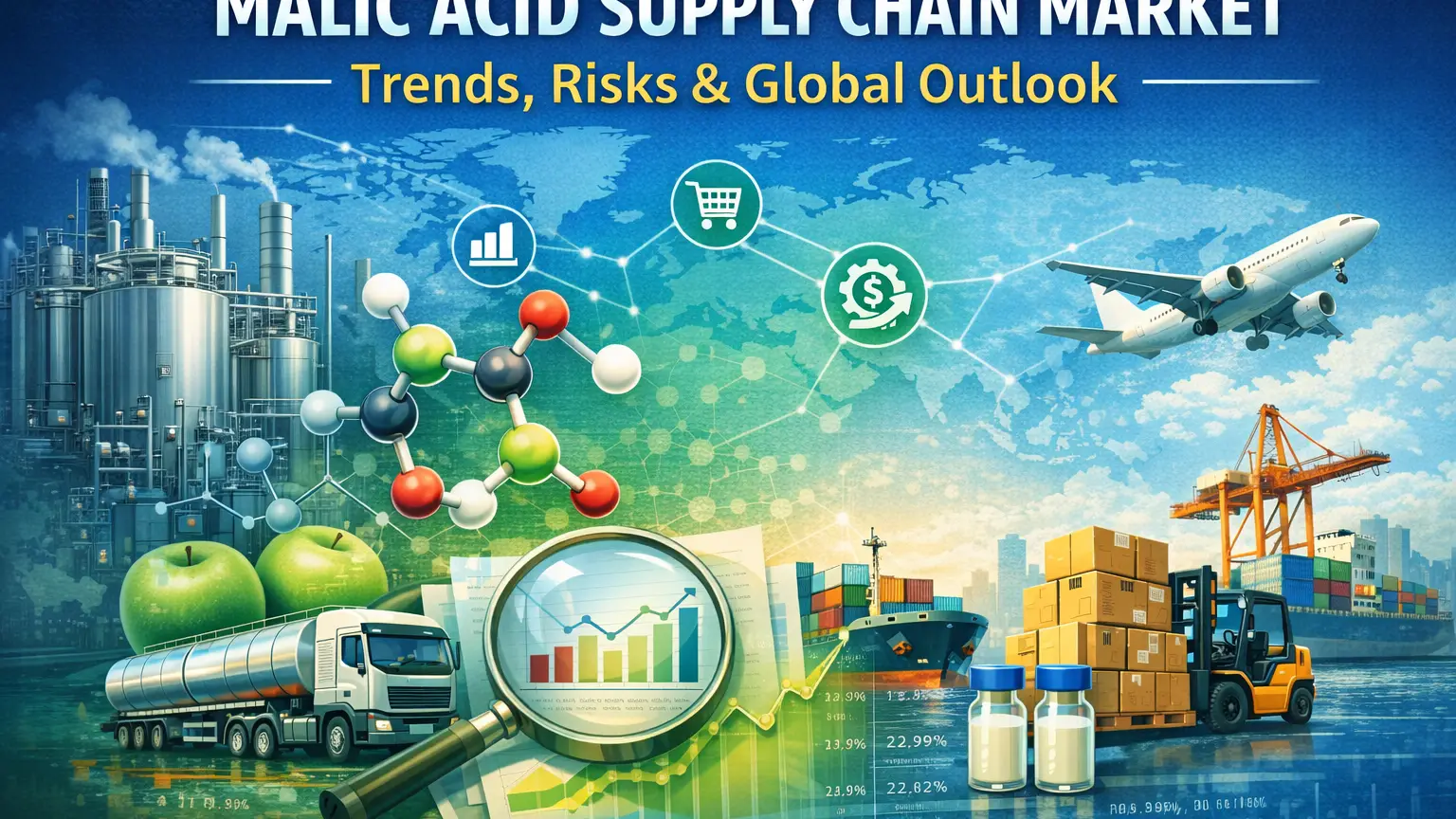
The global malic acid market in 2026 is evolving into a strategically complex supply chain shaped by cost volatility, regional production shifts, and growing demand for sustainable ingredients. Widely used as an acidulant in food, beverages, and personal care applications, malic acid has become a critical component in industrial formulations. With the market projected to grow steadily at over 5% CAGR toward 2030, supply chain optimization is now central to competitiveness and profitability.
Demand Expansion and Downstream Industry Pull
The malic acid supply chain is fundamentally demand-driven, with the food and beverage sector accounting for the largest consumption share. Its ability to enhance flavor profiles and stabilize formulations makes it indispensable in carbonated drinks, confectionery, and processed foods.
Rapid urbanization and rising disposable incomes in emerging economies continue to accelerate processed food consumption, particularly in Asia-Pacific—the region holding over 40% of global market share. This demand surge creates sustained pressure on upstream producers to maintain consistent supply volumes while ensuring quality and cost efficiency.
Raw Material Volatility and Cost Pressures
A defining feature of the 2026 supply chain landscape is the volatility of key feedstocks such as maleic anhydride. Raw materials can account for nearly half of production costs, exposing manufacturers to margin fluctuations.
The industry is also experiencing pricing pressure due to overcapacity, particularly in synthetic DL-malic acid production. Large-scale producers—especially in China—are leveraging economies of scale to offer competitive pricing, forcing smaller players to either integrate upstream or risk margin erosion.
This dynamic has elevated the importance of strategic sourcing contracts and long-term supplier partnerships in stabilizing procurement costs.
Regionalization and Global Trade Shifts
Geopolitical factors are increasingly influencing the malic acid supply chain. Trade tensions, export controls, and regional industrial policies are prompting companies to diversify production footprints and localize supply networks.
Asia-Pacific remains the dominant production hub, driven by cost advantages and strong manufacturing infrastructure, particularly in China. However, North America and Europe are investing in localized production to reduce dependency on imports and mitigate logistics risks.
As a result, supply chains are transitioning from globalized efficiency models to hybrid regional systems that prioritize resilience and risk management.
Sustainability and Compliance in Supply Chains
Sustainability is rapidly reshaping supply chain strategies in the malic acid market. Traditional petrochemical-based production faces scrutiny due to carbon emissions and environmental impact.
At the same time, regulatory compliance has become a competitive differentiator. Buyers increasingly favor suppliers with transparent traceability, certified processes, and adherence to global standards.
Although bio-based production methods are gaining attention, scalability challenges and competition for feedstock inputs remain barriers. Nevertheless, companies investing in green chemistry and compliance infrastructure are better positioned to capture long-term value.
Conclusion
The malic acid supply chain in 2026 is no longer defined solely by production capacity—it is shaped by resilience, cost control, and sustainability alignment. As demand continues to expand across food, beverage, and specialty applications, businesses must adopt more agile sourcing strategies and strengthen supplier networks to remain competitive.
For companies seeking a reliable global partner, Tradeasia International offers integrated sourcing solutions, consistent product quality, and strong supply chain capabilities across key chemical markets. With a focus on transparency and efficiency, Tradeasia supports businesses in navigating the complexities of the evolving malic acid industry.
Sources: