Potassium iodide plays a specialized role in food fortification, particularly in the production of iodised salt. By supplying iodine in a form that manufacturers can incorporate into suitable salt products, this compound supports public health initiatives designed to reduce iodine deficiency.
For chemical traders, food ingredient distributors and procurement managers, potassium iodide represents a niche ingredient market where purity, stability and regulatory compliance matter as much as price. Buyers must also understand that potassium iodide does not suit every salt production process. Its performance depends on salt quality, processing conditions, stabilisation methods and the requirements of the destination market.
As demand for fortified food ingredients continues across global supply chains, understanding how potassium iodide fits into salt iodisation helps buyers evaluate specifications, assess suppliers and make better-informed procurement decisions.
What Is Potassium Iodide and Why Does It Matter in Salt Fortification?
Potassium iodide (KI) is an inorganic compound containing potassium and iodide ions. It typically appears as a white, odourless crystalline solid and dissolves readily in water, properties that make it useful in selected food and industrial applications.
In iodised salt production, potassium iodide serves as a source of iodine, an essential micronutrient that the human body needs to produce thyroid hormones. These hormones support normal growth, metabolism and brain development, making adequate iodine intake particularly important during pregnancy and early childhood.
Salt iodisation offers a practical way to deliver iodine through a widely consumed food ingredient. The World Health Organization (WHO) recommends fortifying food-grade salt used in households and food processing as a strategy to prevent iodine deficiency disorders.
However, manufacturers must select an appropriate iodine compound for their process. Potassium iodide offers specific advantages under suitable conditions, but its stability requirements influence how producers formulate, process and package the finished salt.
How Potassium Iodide Works in Iodised Salt Production
Salt manufacturers generally introduce iodine through a controlled fortification stage. When a facility uses potassium iodide, the production team must distribute the compound evenly throughout the salt to achieve consistent iodine levels across the finished batch.
A typical production approach involves preparing an appropriate potassium iodide solution and applying it to suitable salt using controlled spraying or mixing equipment. The process must account for the salt's particle size, moisture content and physical quality because these factors influence distribution and the finished product's stability.
Potassium iodide requires particular attention to stabilisation. Unlike the more stable potassium iodate, iodide can oxidise into iodine under unfavourable conditions, allowing iodine to escape from the product and reducing the amount retained during storage.
Manufacturers may use suitable stabilising agents or adjust processing conditions according to applicable technical guidance. The precise formulation and iodine concentration must follow local food regulations and the manufacturer's validated process rather than a universal recipe.
Successful production therefore depends on more than adding the right quantity of an iodine compound. Consistent dosing, adequate mixing, appropriate packaging and routine testing all help maintain the intended iodine content.
Why Salt Quality Determines Potassium Iodide Suitability
Potassium iodide does not perform equally well in every salt matrix. WHO guidance distinguishes between iodide and iodate applications, noting that iodide may suit high-quality salt with small crystals, including washed or refined salt, while potassium iodate offers greater stability and wider suitability across salt qualities.
This distinction matters when procurement teams choose an ingredient for a particular manufacturing facility. The supplier's product specification must align with the intended process and the salt's physical and chemical characteristics.
Key considerations include:
Purity and composition: Manufacturers need material that meets the required food-grade specification and does not introduce unwanted impurities into the production process.
Salt cleanliness: Refined salt with consistent characteristics can support more predictable fortification than salt with variable impurities or physical properties.
Moisture management: Excess moisture and unsuitable storage conditions can affect product stability and complicate quality control.
Particle size: Consistent crystal size helps manufacturers assess mixing behaviour and achieve more uniform iodine distribution.
Packaging compatibility: Packaging should protect the finished iodised salt against moisture and environmental conditions that could accelerate iodine losses.
These factors should guide technical discussions between buyers, ingredient suppliers and salt manufacturers before an order is placed.
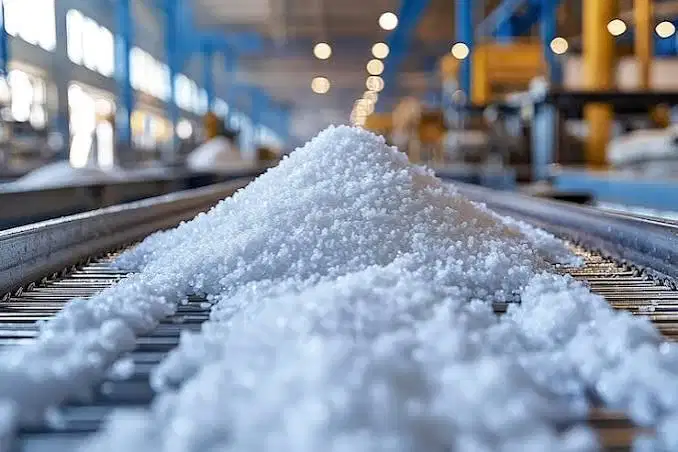
Potassium Iodide Versus Potassium Iodate: What Buyers Should Know
Potassium iodide and potassium iodate both supply iodine for salt fortification, but their chemical behaviour differs. Procurement teams should understand these differences before committing to a product specification or approving a supplier.
Potassium iodide can suit certain high-quality refined salt applications, although manufacturers must manage its lower stability under unfavourable conditions. Potassium iodate generally provides better stability and can accommodate a wider range of salt qualities, making it an important alternative for many producers.
The purchasing decision should consider several practical questions:
Does the salt manufacturer already operate a validated process for potassium iodide?
Can the production line maintain uniform iodine distribution and appropriate stabilisation?
Will the finished product retain its required iodine level throughout the expected shelf life?
Do national regulations and customer specifications permit the selected iodine compound?
The lowest-priced chemical may not deliver the best overall value if it requires process changes or creates additional quality-control challenges. Buyers should evaluate ingredient cost alongside dosage requirements, process compatibility, packaging needs and expected product performance.
Quality Control and Regulatory Compliance in Salt Iodisation
Food-grade ingredient procurement requires careful documentation because potassium iodide intended for salt fortification must meet the relevant food safety and quality requirements. A supplier's general industrial-grade specification does not automatically establish suitability for food manufacturing.
Manufacturers and procurement teams should review the following documentation before approving a purchase:
Certificate of Analysis (CoA): Check the reported assay, relevant impurities and other parameters required by the purchasing specification.
Technical Data Sheet (TDS): Review the material's physical properties, solubility and recommended storage conditions.
Safety Data Sheet (SDS): Confirm handling, storage, transport and emergency-response requirements.
Food-grade compliance documents: Request documentation demonstrating suitability for the intended food application under the destination market's regulations.
Batch traceability records: Ensure that the supplier can identify production batches and provide supporting quality records when required.
Finished salt also requires appropriate testing. Manufacturers need to verify iodine content at the production stage and monitor retention during storage to establish whether the product continues to meet its specification.
The WHO recommends monitoring iodine concentrations in salt alongside population iodine status. Its guidance also recognises that iodine losses vary with production methods, salt quality, packaging materials and climatic conditions.
For importers and distributors, these requirements make supplier documentation and consistent batch quality important commercial considerations. Procurement teams should establish acceptance criteria before shipment rather than resolving specification differences after the material arrives.
Storage, Packaging and Supply Chain Considerations
Potassium iodide requires suitable storage to preserve its quality before use. Buyers should follow the supplier's storage instructions and protect the material from excessive moisture, incompatible conditions and unnecessary exposure to air.
Packaging selection matters throughout the supply chain. Sealed containers or suitable moisture-resistant packaging can help protect the chemical during storage and transportation, while clear batch identification supports traceability between the manufacturer, distributor and end user.
Several supply chain factors deserve attention:
Shelf life: Buyers should confirm the manufacturer's stated shelf life and avoid accepting material that may expire before production can use it.
Transport conditions: Packaging should remain intact during loading, transit and unloading, with handling arrangements appropriate for the product specification.
Lead times: Importers should account for supplier production schedules, documentation review, customs clearance and delivery to the manufacturing site.
Inventory planning: Salt producers should balance reliable availability against excessive stockholding that could increase storage risks or lead to expired material.
Supplier consistency: Repeat orders should maintain the agreed specification, packaging format and quality documentation.
For international traders, these factors can influence the delivered cost as much as the quoted unit price. A supplier offering dependable documentation and consistent quality may provide greater operational value than one competing primarily on price.
Market Opportunities for Chemical Traders and Ingredient Distributors
Potassium iodide sits at the intersection of specialty chemical distribution and food fortification. Its application in iodised salt creates a potential business opportunity for traders serving salt processors, food ingredient distributors and manufacturers that require approved iodine sources.
However, buyers should distinguish between demand for iodised salt and demand for potassium iodide specifically. Some manufacturers use potassium iodate instead, depending on their salt quality, production process and local requirements. This means that market opportunities depend on the technical preferences of individual customers rather than the overall size of the iodised salt market alone.
Chemical distributors can strengthen their position by offering:
Application-specific sourcing: Match the material specification to the buyer's salt production process and intended food application.
Reliable quality documentation: Provide batch-specific certificates and technical information to simplify customer approval.
Flexible purchasing arrangements: Discuss order quantities, shipment schedules and packaging formats that match customer requirements.
Consistent supplier communication: Notify customers promptly about specification changes, lead-time adjustments or documentation issues.
Traceable supply chains: Maintain clear records connecting product batches to supplier documentation and customer orders.
Importers entering this market should also evaluate applicable food import requirements and any national rules governing salt iodisation. A technically suitable product still needs to satisfy the regulatory framework in which the customer operates.
What Procurement Teams Should Prioritise Before Buying
The best sourcing decision starts with a clearly defined application. Procurement teams should confirm that potassium iodide is the appropriate iodine source for the intended salt, then translate the technical requirements into a purchasing specification.
A practical purchasing review should cover five priorities.
First, confirm the required grade and assay with the manufacturer's quality team. Second, establish the relevant impurity limits and documentation requirements. Third, assess the supplier's ability to provide consistent batches and traceable records.
Fourth, compare the complete landed cost, including freight, insurance, duties and any additional testing or handling expenses. Finally, agree on delivery schedules, packaging requirements and procedures for handling nonconforming material.
Buyers should also discuss technical support with suppliers before making a long-term commitment. Where production conditions or national standards change, timely communication can help prevent unsuitable purchases and unnecessary supply disruptions.
For procurement managers, the goal is not simply to secure potassium iodide at a competitive price. It is to obtain a suitable, documented and consistently supplied ingredient that meets the manufacturer's needs and applicable food standards.
Building a Reliable Sourcing Strategy for Potassium Iodide
Potassium iodide remains a useful iodine source for selected iodised salt production processes, particularly where manufacturers work with suitable refined salt and can maintain effective stabilisation and quality control. Its value depends on compatibility with the production system, reliable iodine retention and compliance with the requirements of the intended market.
For chemical traders, importers and food ingredient buyers, successful sourcing requires a balance between price, technical suitability, documentation and supply reliability. Understanding when potassium iodide fits the application, and when potassium iodate may be more appropriate, helps procurement teams make better purchasing decisions.
Acesulfame Potassium (E950) CAS: 55589-62-3
SOURCE LINK: https://www.who.int/tools/elena/interventions/salt-iodization