
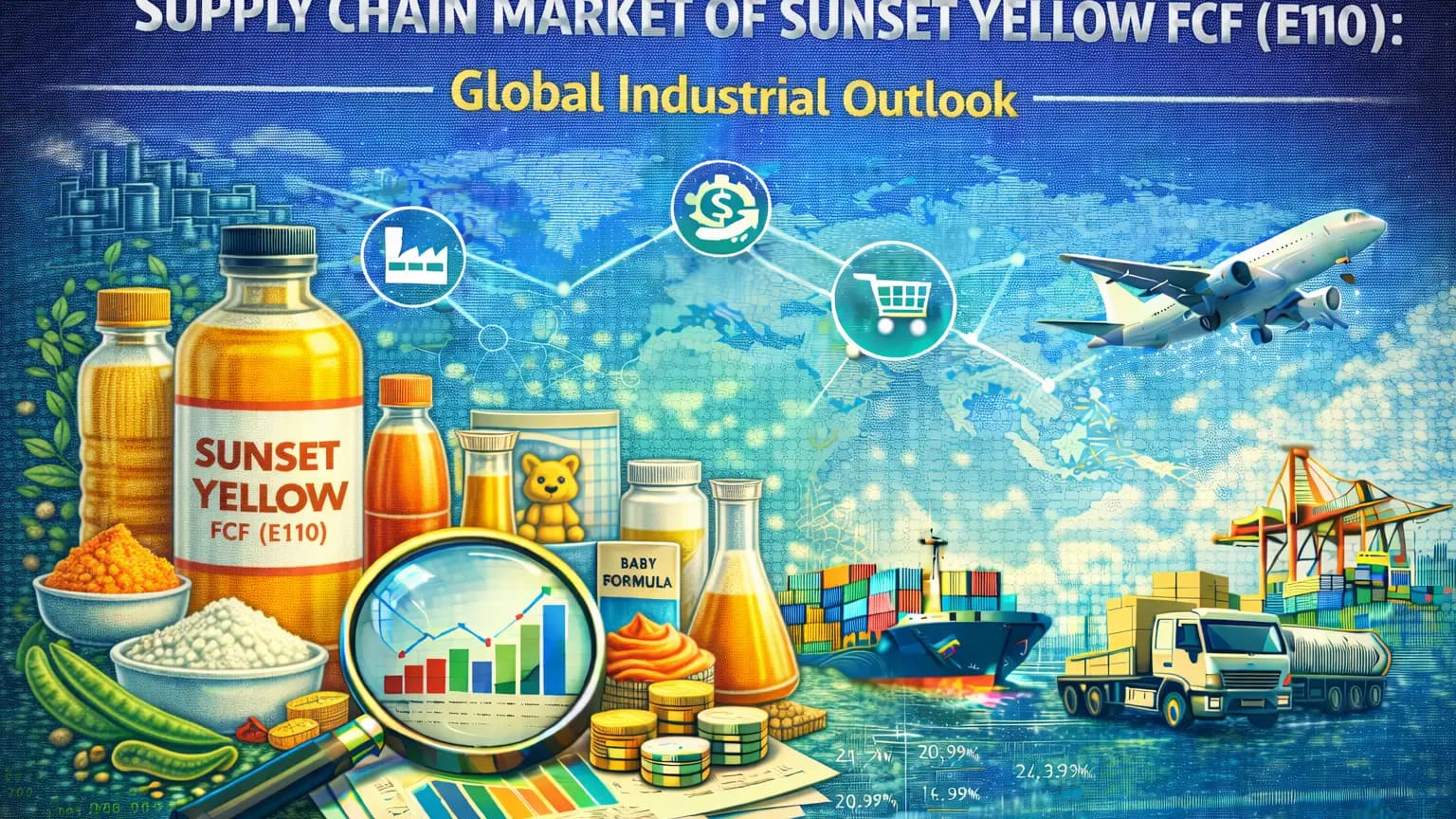
Introduction: Strategic Role of Sunset Yellow FCF in Global Trade
The supply chain of Sunset Yellow FCF (E110), a widely used synthetic azo dye, is a critical backbone of the global food additives industry. As a petroleum-derived colorant used across beverages, confectionery, bakery, and processed foods, its distribution network is tightly interlinked with petrochemical feedstock markets and regulated food manufacturing ecosystems. According to industry analyses, demand remains strong due to its cost efficiency, color stability, and scalability in industrial food production systems .
Unlike natural colorants, Sunset Yellow FCF benefits from a highly standardized industrial production model, yet its supply chain is increasingly shaped by compliance requirements and regional food safety policies.
Raw Material Sourcing and Petrochemical Dependency
At the upstream level, Sunset Yellow FCF production relies on aromatic compounds derived from petroleum refining. This dependency exposes the supply chain to volatility in crude oil pricing and petrochemical feedstock availability. Any fluctuation in upstream chemical intermediates directly impacts production costs and export pricing.
Global chemical suppliers must also comply with strict synthesis protocols due to the azo-dye classification, where purity and contaminant control are essential for food-grade certification. This makes upstream sourcing not just a cost factor but a regulatory checkpoint within the supply chain.
Manufacturing Clusters and Regional Production Hubs
Production of Sunset Yellow FCF is concentrated in large-scale chemical manufacturing hubs in China and India, where economies of scale and integrated chemical ecosystems support competitive pricing. These regions serve as the primary export base for global distribution.
European manufacturers, while smaller in volume, focus on high-purity formulations aligned with strict EFSA guidelines. Meanwhile, Middle Eastern markets, including the UAE, function primarily as import and re-export hubs, distributing the colorant to Africa and South Asia through established trade corridors.
This geographic segmentation creates a multi-tier supply chain structure where cost efficiency and regulatory compliance vary significantly by origin.
Regulatory Compliance and Distribution Chain Complexity
One of the defining factors in the Sunset Yellow FCF supply chain is regulatory fragmentation. While the compound is approved in many jurisdictions under identifiers like E110 or FD&C Yellow 6, allowable concentration levels differ across markets. For instance, European food safety frameworks impose strict usage caps in specific food categories such as sauces and confectionery products .
This creates downstream complexity for exporters, who must adapt formulations, labeling, and documentation to meet destination-country standards. As a result, supply chain actors increasingly invest in compliance tracking systems, batch traceability, and laboratory testing integration to avoid trade disruptions.
Global Trade Flow and Demand-Side Pressures
Downstream demand is driven by processed food manufacturers seeking consistent coloration across large-scale production. The beverage and confectionery sectors remain the largest consumers, particularly in emerging economies where branded packaged foods are expanding rapidly.
However, growing consumer preference for clean-label ingredients is gradually reshaping procurement strategies. While Sunset Yellow FCF remains cost-effective and stable, some multinational brands are diversifying toward hybrid coloring systems or reduced-synthetic formulations. This shift is influencing long-term procurement contracts and supplier consolidation trends across the industry.
Conclusion
The supply chain of Sunset Yellow FCF is evolving under the combined pressures of petrochemical dependency, regulatory divergence, and shifting consumer sentiment. While Asia continues to dominate production, Europe drives compliance innovation, and the Middle East strengthens its role as a distribution bridge. The result is a highly interconnected yet regulation-sensitive global trade network.
In this complex environment, businesses increasingly rely on integrated sourcing partners that can ensure both regulatory compliance and supply stability. Tradeasia International, as a global chemical distribution and sourcing solution provider, plays a strategic role in connecting manufacturers with reliable supply networks, helping streamline procurement and ensure consistent quality across international markets.